Showing posts with label articles. Show all posts

03 July 2011

My Google+ predictions

If you are oblivious about what is Google+, please stop right here and watch this. All the rest of you that are not my mother may keep reading.


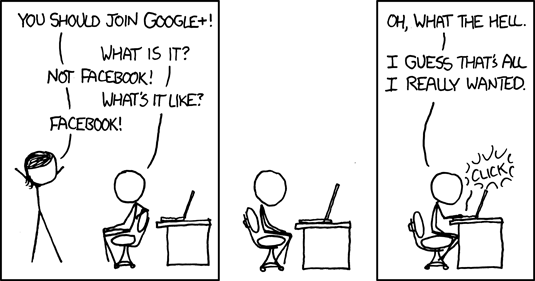
Like the comic above, that is how most people are seeing Google+.

I don't. 

Disclaimer: I am a Google groupie (but I don't particularly hate Facebook, I find it a great tool).

But my prediction about Google+ is that it will win the hearts of the people who have less time for randomness and are more interested in filtering the never ending "I am eating an apple" and "Wow, big poop today". It will become the main tool for meaningful online social interaction.

Why? Good that you asked:

There are 2 key features that distinguish it from Facebook: Circles and Hangout.


Circles

Sometimes I want to share something that everyone might be interested, so I can include all those in the communication. But sometimes I might be feeling down or I got a job offer and I want only to tell my close friends, not everyone. Or, even better, I want to share something only with the people that live in Chennai or only those friends that speak Portuguese. Each of those can be a circle (and a person can be in more circles, for example, I have a circle with my Big Bang team and all of them are also in the circle "close friends", which includes other people also.

How this changes the game: circles will make the smart people think about target audience before they post something. This will reduce the amount of random information one gets, which will lead to more meaningful interaction.

Example:
I was going to share the trailer of a documentary about the making of indie games. Typically on Facebook & Twitter I would just share. In Google+ I thought "hmmm, that really does appeal to only part of my friends, the geek ones, I will make a circle and only share it with them". All the rest of my friends that does not have interest for my geeky stuff will just stay oblivious. I am not interrupting them.

The challenge: for this to happen, people have to be disciplined enough to a) create relevant circles (which demands a bit of time in the beginning) and b) don't act as complete idiots and think about "who would be interested in that post?" Since in the beginning only the tech-savvy will be joining, there is a good possibility it will happen, but once my mom and the rest of the family come (if they will), then I am not sure.


Hangout

Do you have those times where you are really not doing anything and just want to chat with someone randomly? Well, hangout is for you then. You just press a button saying you are starting a hangout and you are moved to a virtual room with video chat and people can come to chat with you. 

"Oh, this is not new! It is Chatroulette! It has only perverts chatting with strangers!" will scream the troll.

No, no, my dear troll friend, the catch of the hangout is simple: only the people in specific circles of your choice may join the hangout. I am a almost 30 year old guy, when I was young there was no web or even mobile phones (yes, there was a time those didn't exist!), how did we meet our friends? We used to HANGOUT in the same place and time, so the people from that group would join eventually. Like the cafe where the people from Friends used to go.

How this changes the game: I want to talk, but I am not available to everyone, I am available to only a few friends. It also removes the barrier to "schedule a chat" or anything like this in Skype. You just start hanging out and a friend will join to chat. It just blew my mind - and I didn't even talk about the extra spicy stuff, like this room can have up to 10 people using video chat, you can share Youtube videos that you all see at the same time, etc.

The challenge: without critical mass (a lot of people using Google+), this is still only a gimmick.

Google+, you will put fear in Facebook, Twitter and Skype. I want you to win.

11 June 2011

When research proves the obvious, why do you need it?

There is a prevalent thought in the business world about the importance of data and research. I have seen places where people can only take decisions if it is absolutely proven by a respectable research firm that a certain course of action or element brings results to the bottom-line.

I am not against data, I am in fact a rather logical and analytical person, but data can only take you so far. The worse of all is when data becomes so important that you start wasting research money on things that should be common sense for anyone with a bigger brain than a monkey. Example: I recently read in McKinsey Quarterly (definitely a place where you have a hell lot of insanely smart people) an article about how talent made the difference in R&D.

What? So you are telling me that putting smarter and more talented people with good cultural fit in a highly intellectual-collaborative activity such as research and development will bring better results than putting incompetent ones? REALLY? That is new *raising the sarcasm sign*. Do you really need a research to show something that obvious? Apparently we do, because (lots of) managers are so obsessed with data that they are completely paralyzed if there is no research that proves a point.

The McKinsey research is not bad and there are useful data there on what are the best initiatives to have a talented team (unsurprisingly, one of them is only recruiting good people, looking not only for current skill, but also potential). Look, in my first leadership role, in a STUDENT organization, we knew that intuitively - fire under performers, hire only A-players, let them work, repeat.

Besides wasting resources with such research, there are 2 main disadvantages of relying too much on data to make decisions:

1 - You start late. If there is time to make research about the results something brings, someone else already tried it and is ahead of you. And while you are trying to copy their results, they already moved on the next level. It is a never ending catch game.

2 - You will miss the insights. Old anecdote: if Ford had made a research with his customers, the data he would have got is that people needed faster horses. Data cannot predict black swams.

28 March 2011

What the most admired companies actually do (without blablabla)

FORTUNE magazine recently released its annual list of theWorld’s Most Admired Companies and as we do every year, my colleagues and I at Hay Group took a deep look at the companies that made the list to determine what makes them “tick,” how they earn the admiration of their peers, and what organizations and leaders can learn from the practices of the “Most Admired” companies.
You can read the original article here, or you can skip the blablabla and just go straight to the point of what they do better:

1 - Empower employees at all levels to take decisions and "reasonable" risks, pushing decision making the closest to the action as they can. Less red tape = quicker problem solving (sometimes even before it become a problem).

2 - Ask employees for their input, involve everyone in problem solving.

3 - Ongoing employee development.

Now we know why just a bunch of companies are most admired, while others are ignored. The winner takes all in the war for talent.

21 March 2011

I have no time for important things because I waste 40% of it

From the Future of Work blog:

The paradox at the heart of work

So here is the thing… last week I heard two paradoxical facts:
Fact 1 – we have no time. 
We are nearing the end of our research consortium focused on the future of work and need to ensure that the ideas that have come from the research are translated into facts, ideas and actions for the companies that have participated. That’s going to take time – perhaps four hours a week of focused team-work to ensure the translation takes place. Yet when we ask executive teams about putting this amount of work in thinking about the actions for the future, the overwhelming response is that many teams are simply too busy to dedicate this time. It’s not that they don’t think this is important for the future – but as often happens at work, the short term is overwhelming the longer time priorities. So – the first fact I heard this week is that many executive teams simply have no time for this type of longer-term work.
Fact 2 – we waste 40% of our working time.
That reality was in my mind when I worked earlier in the week with a major US based multinational company. The team was mulling over the results of an analysis of the working patterns of hundreds of employees they had commissioned. What was clear was that more than 40% - yes you have heard it right – not 4% but a full 40% of work currently being undertaken was not actually productive work. Doing stuff that was not needed, working on projects that had no significance, going to meetings that had no outcomes.
Now the paradox emerges. At the very time that we are overwhelmed by the minutia of everyday work – we are simultaneously engaged in work that has no productive outcome. Now that’s interesting. 
So how has this happened? If you want to check what Lynda Gratton think about it, just go to the original post, but here is my simple take on why is that:

1 - Strategic direction / vision is not clear enough (not 100% actionable by every employee) - "increase sales", "grow", etc can be interpreted in a million ways. If it is not clear, at best, I will have my own take to do it. Which can lead to a lot of spinning wheels or rowing the boat to the wrong shore. This leads to problems in prioritization, which end up as the "everything is a priority" mindset. When everything is a priority, then you will be counting on luck to pick the really important things to get done. Work is infinite, time is not.

2 - Bad management skills - if the above problem is more connected to leadership, this one is purely management: effective meetings with clear output, clear delegation, scraping the BS and focusing on the priorities, etc. In my short corporate life (around 8 years), I am absolutely overwhelmed by the amount of people who cannot create a simple plan, run a meeting where people know the objective, delegate something with clear deliverables and satisfaction conditions, decide something when a decision is needed, etc. I strongly believe this should be tough in schools, that is basic education nowadays: getting stuff done.

13 January 2011

Will the middle manager job disappear?


At least Lynda Gratton, from the Future of Work, think so. She thinks there are 4 reasons why the disappearance of the middle manager is on the cards: 
  • Technology has become the great general manager. It can monitor performance closely, provide instant feedback, even create reports and presentations. When technology can play much of the role of the manager – why have one?
  • Skilled team members are increasingly self-managed. That’s not to say they need a team leader – but this is likely to be taken from a member of the team who is highly skilled and it could well be a rotating role. So when teams can manage themselves – what can a general manager add? 
  • Attitudes toward management have also changed. As my research makes clear, Gen Y workers see no value in reporting to someone who simply keeps track of what they do, when much of that can be done by themselves, their peers, or a machine. What they do value is mentoring and coaching from someone they respect. Someone, in other words, who is a master—not a general manager.
  • It was possible in the past to manage ‘intuitively’ and for good management skills to come as part of the whole ‘decent person’ angle. Now management is fiendishly difficult – particularly if people are located virtually across the globe. These situations take extreme specialist skills to lead.
I couldn't agree more. But I also have another reflection on it: while the classic middle manager is subject to extinction from all the above, the job of the "middle leader" (?) will always be necessary. The leader, capable of shaking the status quo, driving change, inspiring, bring a strong team together like glue, pointing to the right direction and making people lose sight of distractions, will always be necessary. The difference might be that MAYBE we will evolve so much that anyone and everyone will be expected, capable and responsible for playing this role (which I think we still have a loooong way to go to get there).

For now, no machine can beat the gift of the linchpin.

17 November 2010

"Retail Is War Without Blood": What Foot Locker's CEO Learned in the Army


Ken Hicks, the CEO of Foot Locker, formerly the president and chief merchandising officer of J.C. Penney's, graduated from the United States Military Academy and spent six years in the army just after the Vietnam War. HBR talked to Ken about how his time as a young officer prepared him for a career as a retail executive.


Tell me about a couple of things you learned from your military experience that have made you a more effective CEO.
When I took over my artillery battery, at age 25, I could shoot a cannon better than any of my section chiefs. And I had six guns. The only problem is, I could only shoot one gun at a time. I realized that what I had to do was train my section chiefs to be better cannoneers than I was. Because shooting 18% of the battery isn't going to be effective. And my job really wasn't to shoot a cannon, it was to develop an entire artillery battery.

So I learned that you're very dependent on your people to be their best. You train and develop and motivate them. People think in the army that you tell somebody to do something and they do it, and that's far from the truth. They actually have more options and pressures that can be very intense. Think about it — if somebody in Afghanistan screws up, they get sent back home. If they don't, they stay in combat.

To be a successful leader, you have to understand what skills are required and be competent at them, and you also have to have confidence. Sometimes people mistake confidence for leadership, or competence for leadership, but it takes both of them together.

Do you see any connections between how the military and the retail industry operate?
In retail and the military, you're very dependent on the people at the front or the selling floor. You realize how important the sale associate is. It's the same thing in the army; you're very dependent on your privates and specialists, and so you talk with them and learn from them. Six or eight months after I'd left J.C. Penney's, I was in a Penney's store looking at some merchandise, and an associate recognized me and came running across the floor to say hello. She remembered me because I'd treated her with respect and listened to her. That's what you have to do to inspire people. The people on the selling floor, just like the cannoneers, the gunners, and the infantry, are the ones who make everything happen.

How do you stay connected to frontline employees, besides going out and talking to them?
Recognition. I send out a little note card every month to the employees who perform best, thanking them for doing a good job. If you think about the military, people are willing to give their life in defense of the country and their friends, and what do they get for it? They get a ribbon on their chest. Everybody thinks recognition needs to be a big bonus or a promotion. It really doesn't. What you learn in the military is people do their work because they trust and respect you and they want you to be able to recognize them for that. I send out these cards and the next thing you know, they frame them and put them on the wall in their stores or their cubicles because it's important to them.

What else has made you successful as a senior leader?
Learning and studying each situation. When I was in the Army I had the opportunity to have lunch a couple of times with Omar Bradley. Here's a guy from history who led troops across Europe and commanded the war in Korea, and people would always ask him, who is the greatest general you served with? And he would say the greatest field commander was Patton. That's because Patton did his homework, he studied the map, and he knew where the enemy was going to be and where they needed to go. It's the same in business. You have to study the numbers and constantly try to understand where the opportunities are and how you can go after them.

I've got on my wall in my conference room the principles of war. And each of the principles of war apply in business. For example, mass: don't spread your troops out, don't spread your resources too thin. Unity of command: know who's in charge, who has responsibility and who doesn't. Security: don't be surprised, study the competition, know what's happening. I worked with a retailer who said, "Retail is war without blood." You study and spend a lot of time understanding the competition's situation. You learn not to overreact.

How do you communicate a clear mission?

You have to constantly reinforce it, so people always know why you're doing what you're doing: we're going after this because of that. Then people know why they're there and what they need to focus on and what they should do. You can empower them. One of the differences between our army and the Soviet army was that our tanks all had radios; every tank could communicate with every other tank. You could see the difference that made in mock battles. In the Russian army, the tank commander had a radio, and the platoon leaders, and all the other tanks just followed the leader and did whatever the leader wanted. If something happened to the leader's tank or they were lost, they didn't know what to do.

I assign a lot of projects to people and say, here's what we want to accomplish. You're the lead; you have responsibility. You bring the resources to bear, and let's accomplish it.

You're in a pretty volatile industry. How have you adjusted the way that you go about planning to take into account the rapid nature of change?
Constant communication and watchfulness. When I was in the army I was in a cavalry regiment, and one of the cavalry's jobs is to go out and scout. I send people out to our competitors' stores all the time. We look at the competition, the press, any venue we can think of where we will see new ideas and new things.


by This post is part of an HBR Spotlight examining leadership lessons from the military.

07 September 2010

Good leaders shield their people from wasting their time and organizational idiocy

The article is in fact "Why good bosses tune in to their people" in McKinsey Quarterly, but I found particularly good the part that says about shielding their followers - something that I recon, in the beginning of my term as president, I didn't do so well, but then I think I managed to improve. Here is that part of this interesting article:

The best bosses invent, borrow, and implement ways to reduce the mental and emotional load heaped on their followers—and protect them from the incompetence, cluelessness, and premature judgments of fellow bosses or others who can undermine their followers’ work and well being. Followers who enjoy such protection (and who may be bosses themselves) have the freedom to take risks and try new things.


Annette Kyle, for example, managed some 60 employees at a Texas terminal where they loaded chemicals from railcars onto ships and trucks. In the mid-1990s, Annette led a “revolution” that dramatically raised her unit’s performance through a host of changes, including better planning, greater responsibility at the lowest levels, improved and more transparent metrics, and numerous cultural changes. She personally sewed “no whining” patches on workers’ uniforms, for example, to discourage the local penchant for complaining and auctioned off her desk to workers for $60 because, as she explained it, “I shouldn’t be sitting behind a big desk. I should be contributing to team goals however possible.”

This transformation virtually eliminated the penalties that were levied when ships arrived at the terminal’s dock but (despite considerable advance warning) workers weren’t ready to load them. These “demurrage charges,” which cost the company $2.5 million the year before the revolution, were down to $10,000 the year after. Previously, it had taken more than three hours to load an average truck. Afterward, more than 90 percent were loaded within an hour of arrival. Surveys and interviews by University of Southern California researchers showed that employees became more satisfied with their jobs and felt proud of their accomplishments. I asked Annette how she could make such radical changes in her giant company. She answered that her boss shielded her from top-ranking managers—he found the resources and experts she needed but never discussed these moves with senior management until they succeeded.

Good bosses are especially adept at protecting their people’s time—for example, by eliminating needless meetings. Take a cue from Will Wright, designer of computer games such as The Sims: rather than automatically scheduling meetings, ask yourself if they are really needed. Wright employed a clever trick. Every time someone called a meeting, he charged that person a dollar. Although he collected a lot of dollars, this requirement made people “think twice, even though it was only a dollar.” He also used an employee-centered method to keep meetings short—inviting the creative but impatient artist Ocean Quigley, “the canary in the coal mine.” When Quigley raised his hand to be excused, “we knew that the meeting had hit diminishing returns.”

16 August 2010

Learning leadership again and again everyday

According to a research made by the Corporate Leadership Council, the ten most important leadership characteristics are:

1. Honesty and integrity
2. Clearly communicate expectations
3. Recognize and reward achievement
4. Adapt to changing circumstances
5. Inspire others
6. Put right people in right roles at the right time
7. Passion to succeed
8. Identify and articulate long-term vision
9. Persuade and encourage others to move in the desired direction
10. Accept responsibility for successes and failures

Sounds great and I fully agree they are definitely outstanding characteristics that will make a leader successful. BUT, here is the catch, no one can be perfect in all of those, all the time, with all the people. Read the list again and check out, each of these characteristics can be subject to very wide interpretations. And, if there is big room for interpretation, there is a big room for the same behavior that subject A consider as “honesty and integrity” be considered “too direct and hash” by subject B. Worse: the same behavior can be identified as “honesty and integrity” or “too direct and hash” by the same person, depending on the mood he/she is in the moment or the subject the leader is touching.

What now? Despair? Chaos?

No, business as usual for leaders: adapt constantly to the people. For each person, you have to “learn” leadership again. Maybe even for every moment. Leadership is being 100% present at the moment – which is weird because one of the main characteristics of leaders is to look to the future and articulate the long-term vision. Well, no one said it would be easy :)

07 August 2010

Become a 100% leader

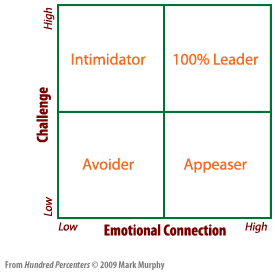
Mark Murphy, CEO of Leadership IQ, says that the “two most important differentiating factors in separating exceptional from average leaders are Challenge and Connection.” Challenge is the extent to which a leader pushes his or her people. Connection is the strength of the emotional connection they build with their people. You need to decide how much you want to challenge your people and how tight an emotional bond you want to build with them.


Working for the Appeaser. You’re given enjoyable assignments, you’re allowed to spend most of your time on work that plays to your strengths, your boss gives you lots of positive feedback, and your boss seems to care most about making sure you’re really happy.

Working for the Intimidator. You’re given seemingly impossible assignments; you don’t feel like you’ve got all the skills you need to complete those assignments; when your boss gives you feedback, it’s usually pretty harsh and critical; and your boss seems to care most about achieving his goals no matter who’s with him at the end.

Working for the Avoider. Your boss doesn’t really force too many assignments on you, you’re not really required to learn new skills, your boss lets you figure out for yourself how you’re doing, and your boss seems to care most about not getting in your way.

Working for the 100% Leader. You’re given really challenging assignments, you’re required to learn new skills even in areas you might not consider to be your natural strengths, your boss gives you lots of constructive and positive feedback, and your boss seems to care most about pushing you to maximize every ounce of your potential.

What kind of leader are you? What kind is your leader?


From The Leading Blog.

04 May 2010

The coming melt-down in higher education (as seen by a marketer)

Spot on Seth Godin's semi-rant against the traditional higher education (especially the schools with tradition). Since I am both a fan of Godin and a criticizer of traditional educational system, that's my recommendation for you to read it.

And one thing that one of the best leaders I have the pleasure to work with always told (about his own delays with his education): "Steve Jobs never finished his degree."

28 April 2010

Women versus men pay - a question of behavior, not sexism?

I just read an intriguing article that suggests that women earn less than men not because of gender inequality, but because women tend to have a more "soft" and less "Machiavellian" approach then men, which are more prone to be aggressive, lie, cheat and do whatever to raise profit. The article concludes that for a better pay equality between the two genders would be to punish more bullies and cheaters.

Does this make sense? I don't know, but I have a twist for this logic: we are (slowly) walking to the path of sustainability, thinking on consequences, CSR and more compassionate way for business success. Would this mean that, when this trend is on its highest, women would earn more than men  because they are much more prone to thinking like this?

23 April 2010

How to fire someone that is not performing according to the standards set?

In AIESEC Norway in the past months we had a drastic reduction of the amount of people recruited and a drastic increase in the amount of people that we had to "let go" because they didn't fit the performance standards we were looking for. And, yes, we are a volunteer organization. Volunteer? Yes. Firing people? Yes. We have a saying around here "you are volunteer to join and volunteer to leave. In between you work your ass-off". And I am proud of this and the people who made it happen - because it was not me who was on the frontline, firing people, it were the courageous leaders on the local level that had to have difficult conversations.

Lots of them asked me "but how do I fire someone?" And I had no clue how to do it, I just tried to support them as I could.

But this doesn't happen only in a volunteer organization, in "normal" companies that's the same dilemma, no MBA will ever teach you to fire someone, you will only learn when you actually do it in practice. And here is a copy paste of the article about it:


When I teach MBAs, we talk about firing people with the cold and academic clichés of "down-sizing," "right-sizing," "letting someone go." But have you ever fired someone? As a construction superintendent, this was a major part of my job. These terms are bloodless and fail to capture the true intensity and anguish that goes with looking someone in the eyes and telling him he's out of a job.
It wasn't until I had fired fifteen people in 12 months that I began to see things differently. One carpenter had made a costly mistake on a master bedroom porch; it was one of many costly mistakes. I caught a second carpenter finishing the last of his whiskey nip. The third had been coming in late and his effort on the job was weak. Some of the carpenters had complained when they were teamed up with him.
Within 15 minutes, all three were given their final paychecks and told to leave. And yet, despite my clear justification in making the moves, I was still filled with doubts. I invited one of my trusted carpenters, Benjamin, for a beer after work.
With a full mug in front of me, I poured out my feelings. "Benjamin, I don't know how many more times I can do this. I don't even know if I did the right thing."
"Andy, you had to do it. Those guys weren't carrying their weight."
"But now they're out of work. I can't help thinking about that."
Benjamin agreed, "Yup, that's true. Some people are out of work today. They're not getting a paycheck. But this is happening at other job sites around the state too. It's not your fault."
"So you mean I have no choice in the matter? No say? I'm simply carrying out what needs to be carried out?"
"Well, sort of."
"That doesn't make me feel better. I made the decision to fire these people. If I decided not to, they'd still be employed. I wonder if the other guys live in fear that I'm going to fire them?"
"Now wait a minute, Andy," cautioned Benjamin. "You're making it sound like your decisions were arbitrary. Were they?"
"No."
"Right, you made these decisions for a reason. Don't you think the guys that got fired know that? And," he paused, "Don't you think the guys that are still on the job know that too?"
"Yeah, I guess so. But I wonder what they see?"
"They see someone who's trying to hold a high standard of work. Stop thinking about the guys you fired and start thinking about the guys you still employ. They're the ones who deserve your attention."
Benjamin's lecture was a turning point, a watershed in my thinking about what I was doing and why. The pain of telling someone that he was fired would always be difficult, but the pain lingered less if I focused not on who left but on who stayed. My notions of building a crew took on new meaning. The idea of one stable and permanent crew was dispelled, replaced by the idea of a constantly evolving crew.
That's not to say that it stopped being painful to let someone go. And in fact, that pain should never go away. You're severing a relationship and creating hardship for someone. But you have to look at why you are doing it, how you are doing it, and what you are creating in the process.
In some cases, I learned that everyone knew a person had to go and they were waiting for me to do it. And by letting the person go, the people I left behind felt better about working for me. They saw that I had high standards and they were meeting them. They worked harder, with more pride, as long as I held the whole crew to the same high standard and did my job by weeding out those who didn't meet it.
The key here is building a culture of quality and pride. And I, as the leader, was responsible for establishing that culture both by deciding on its membership and also determining the rules of maintaining that membership. This goes far beyond the formal processes of recruiting and training. This puts the human face on a human process.

22 April 2010

Making a newly hired/promoted to perform instantly

Organizations tend to believe that you can't get value for newly hired people. The concept is simple "they need to understand first how to get things done in the organization, then they can get it done". Even though this mentality is changing in AIESEC Norway, still some local committees have this attitude too, letting their newly recruited into "learning mode" for too long.

I have 2 good reasons for not doing this, but instead put the person in deep water from the first day:

#1 - training is overrated, no one can truly learn the work without practicing the work. Even though most organizations still put more money in theoretical learning than in anything else that should generate learning.

#2 - because Halvard Business Review said so. See part of the article bellow:


Case Study #1: Working within the first five minutes on the job
Michelle Pomorksi, started her job as a contract programmer at the software design and development company Menlo Innovations after an intensive hiring process. Within five minutes of walking into the office in Ann Arbor, Michigan, Michelle was working on a project. This wasn't an "onboarding project" but a real one for clients. She was "tripled" (that's company lingo for teamed with two other people) and sent off to a client site to do interviews. Rather than observing, Michelle actively participated and was expected to contribute by asking questions.

Rich Sheridan, founder and CEO of Menlo, thinks he has created a unique process to get new people productive faster than at other software companies. Every new hire is immediately paired with a current employee to do design and development work, in what the company calls "paired programming." Pairs are switched every week so by the end of the first three weeks, a new person has three mentors to rely on for advice and help. Even better, after the initial three weeks, she is ready to mentor someone new. "The real power is in the pairing," Michelle says. "There isn't one day I've gone to work that I haven't learned and taught at least one thing."
The process is facilitated by an open work space: Menlo doesn't have offices, cubes or doors. Rich thinks his hiring and onboarding strategy gives him an advantage over competitors because he can seamlessly expand and contract his work force according to client demand. It also makes employees enjoy a task they might otherwise dread. He acknowledges that onboarding this way requires careful attention to how pairs are put together and a good deal of orchestration. But he does not see it as a loss to productivity. "I probably get four times as much work done with two people pairs than most people get with two individuals," he says.
Case Study #2: Start early and see the whole picture
Pat Lee, a top Marketing Director at Johnson & Johnson Asia, happily received a promotion to Vice President of Marketing. But, she was not fully prepared for the suddenness of the promotion and all that it entailed, including relocating to a different country. She immediately began planning the logistics of the move: deciding which town to live in, exploring job prospects for her spouse, investigating schools for her children. She expected to have all these details worked out in advance so that she could "hit the ground running" on her first day in the new job.

However, Joe, her HR business partner, urged her to begin the transition to the actual job before she made the move. He suggested she take a "transition risk assessment" to help her better understand the challenges she faced in the new role. This helped Pat to fully see the situation she was getting into and better understand herself. It uncovered several issues: she had never worked in another country before; she had never taken on a regional role; she had minimal understanding of how her company did business in other countries; and she had little knowledge of the people on her new staff, the office politics, and how things got done. She also didn't know what her new boss expected of her and what phase of operation her businesses were in — start-up, turnaround, downsizing, optimizing on-going, etc. She realized she needed to address these problems and so with Joe, developed a Transition Acceleration Plan and started working with a coach, who helped her by interviewing her boss, direct reports, and colleagues to get honest feedback about their expectations. Doug Soo Hoo, former Director of Learning and Development at J&J, explains that this intense process is "a good way to get out of 'sink or swim mode' and an investment in the company that also shows a caring for the success of the individual."
After three months on the job, Pat's boss and her peers gave her rave reviews on how quickly she had mastered the "ins and outs" of the new situation and taken actions to address them. One of her new reports said it was almost as if she had been in the division for years.

To read the full article, click here.

What I want to say with it? Simple: put your new executive board to work now and make sure that the new members joining are not expected to stay in "learning mode" for long time. Start working now!

15 April 2010

What NGOs need to do to gain respect

They need to:
  • Make an honest assessment of their core competencies, competitors and consumers so that they understand and can articulate where they fit in the marketplace -- and make a market play if they can deliver a competing service more effectively. The end goal is to solve problems, not get along, right?
  • Take more risks in how they deliver solutions and how they fund them. The status quo is not enough, so think big and act accordingly.
  • Say no to funders who demand new programs or changes to programs that detract from the organization's theory of change or core competencies.
  • Diversify revenue streams so that they are not beholden to any one funder or funding stream.
  • Demand that board members invest significant time and money in the organization, or get out.
  • Fire under-performing staff. This is such a taboo in the sector, but with limited resources and mounting social problems to be addressed, do we really have time to invest in people who can't deliver?
  • Be brutally honest with funders, board members, others about the true costs of running operations effectively and don't apologize for, or hide, administrative expenses
  • Create a bold strategic plan that will drive the organization toward social impact and sustainability, not mediocrity.
From Change.org.

That's exactly what we have been trying to do in AIESEC Norway - and we are beginning to see the successes of it. I still love one of the quotes from one of our members "AIESEC is volunteer? Yes, volunteer to join, volunteer to leave, but while you are here you work your ass off".

10 March 2010

The 8 things people expect from their leaders

Sent to me by my "boss", from HBR:

(...)

1. Tell me my role, tell me what to do, and give me the rules. Micromanaging? No, it's called clear direction. Give them parameters so they can work within broad outlines.


2. Discipline my coworker who is out of line. Time and time again, I hear, "I wish my boss would tell Nancy that this is just unacceptable." Hold people accountable in a way that is fair but makes everyone cognizant of what is and isn't acceptable.


3. Get me excited. About the company, about the product, about the job, about a project. Just get them excited.


4. Don't forget to praise me. Motivate employees by leveraging their strengths, not harping on their weaknesses.


5. Don't scare me. They really don't need to know about everything that worries you. They respect that you trust them, but you are the boss. And don't lose your temper at meetings because they didn't meet your expectations. It's often not productive. Fairness and consistency are important mainstays.


6. Impress me. Strong leaders impress their staffs in a variety of ways. Yes, some are great examples of management, but others are bold and courageous, and still others are creative and smart. Strong leaders bring strength to an organization by providing a characteristic that others don't have and the company sorely needs.


7. Give me some autonomy. Give them something interesting to work on. Trust them with opportunity.


8. Set me up to win. Nobody wants to fail. Indecisive leaders who keep people in the wrong roles, set unrealistic goals, keep unproductive team members, or change direction unfairly just frustrate everybody and make people feel defeated.
(...)


That's a quite good and to the point list. I like especially number 8. I have this "mantra" to myself, something like "if we are going to make mistakes, let's make them quickly, so we can also try something different quickly". I value so much people that can be decisive as leaders. It takes balls to do so, because, as a leader, "everything is your fault (dot)" and sometimes people believe it's more comfortable to not decide.

I prefer to take a decision, even not knowing if it's the right one (not even mentioning the "perfect decision", which is probably an unrealistic concept anyway). If we new all the answer and had all the information we needed to make a decision, even a monkey could run a business. Leadership is about uncertainty and belief, management is about certainty and facts.

09 March 2010

8/march was yesterday, but people still don't get what is women's day

My friend Jake sent us because it concerns the Norwegian reality:

-----------------

Adding Female Directors Hurts Norwegian Firms' Value

Minus 18%. When Norwegian companies increased the proportion of women on their boards under a new diversity law, the firms' market value suffered, according to Amy Dittmar and Kenneth Ahern of the University of Michigan. If a firm achieved at least a 10% increase in the proportion of female directors, its Tobin's Q — the ratio of market cap to asset-replacement cost — dropped 18%. But gender wasn't the reason, the researchers contend; the decline was due to the new directors' young age and lack of high-level work experience.

Source: Stephen M. Ross School of Business at the University of Michigan
-----------------

Talk about understanding the importance of gender equality and doing it wrong by enforcing laws and regulations that demand unqualified people to take the job of qualified ones. We have the recognize the value in every individual, not force an idiot policy of "let's be nice to these poor little girls". Putting women in the board room that shouldn't be there is also undervaluing them. I can almost hear the male board members telling sexist jokes about the women who were put in the board room for questionable reasons. Is this better? Really?

27 November 2009

Are You an In or an Out Leader?

How much time and energy are you spending in (or with) your team and how much time out in the wider organisation? It might seem like a simple question, but executives rarely take the time to think about it. It's important to do though, because this single question could answer many other questions that you — or your boss — have about your style and effectiveness.

Executives usually have a preference for one arena, which can be reinforced by their role, their personality, or even the corporate culture. A quality control manager, for example, would naturally be more inwardly focused while a communications director would roam across the business. Both roles would attract different personalities. Similarly, some organisations are structured as, or have developed into, silos due to the nature of their business or markets. Examples might include law firms, where separate practices evolve to serve clients in specific areas.

My suggestion is that executives need to balance the time they spend in both the In and Out arenas if they are to be effective.
via blogs.harvardbusiness.org

14 November 2009

What great managers do

Great managers set expectations. Expectations are the milestones we use to measure our progress and, within the workplace, mark the pathways that guide us toward achievement.

Great managers define the right outcomes first, and then let each person find his or her own route toward those outcomes. This approach allows the individual to grow via the discovery of his or her "path of least resistance." It appreciates and values differences between employee styles and lets people capitalise on their strengths to achieve their fullest potential as well as encourage responsibility.

Give the opportunity to do best. The task of the best managers is to clearly define the talents needed for each role, and then choose the right person for that role. A manager's job is not to make people develop talents they do not have, but to identify and utilise their existing talents to their full potential, and give them an "opportunity to do what they do best every day."

Genuinely care. Gallup finds that great managers possess identifiable talents or recurring patterns of thought, feelings and behaviours. These managers find a true sense of satisfaction when their staff develop their skills and succeed, even if the employees' success surpasses that of the manager. They genuinely care about the people they work with.

Encourage opinions. Great places to work are those where employees' opinions count, encourage great ideas to flow and be heard, and then processed and refined.

Not all ideas will be successfully implemented, but the process of refining ideas is still wonderfully productive -- it builds employees' confidence in the firm and shows that their efforts can make the firm better.

Great managers never ask employees for their opinions and then do the opposite without a clear explanation.

Explain the company's mission [[AIESEC WAY]]. Great workplaces give their employees a sense of purpose, help them feel they belong, and enable them to make a difference.

Every individual has a unique sense of purpose, and individuals find different meanings in similar situations.

Great managers continually strive to help individuals understand how the firm's purpose/mission directly relates to individual duties.

Keep employees doing quality work. Often, the definition of quality sets the tone of a workplace culture. If quality is defined as the absence of defects or mistakes, we indirectly encourage employees to cover up mistakes or problems quickly.

Great managers realise that human beings make mistakes, and can learn from correcting them. In healthy workplaces, staff are being challenged to improve their product or service by defining "quality" as the process of recognising and solving problems.
A problem can also bring out a greater sense of teamwork. Employees who are committed to doing quality work know that a problem can improve team cohesiveness. They use the power of the team not only to overcome the crisis, but also to correct the process to avoid future problems.

Encourage learning and growth. Every day, great managers face the challenge of creating a culture that is open to new ideas and lets employees explore possible implications of those ideas without fear of rejection or retribution.

For employees, the creation of a culture receptive to new ideas also involves significant belief and trust in their managers and teams. A company's future is dependent on the learning and growth of the employees who are closest to the action.
Great managers, employees and teams are rarely quite satisfied with current ways of doing things. They always feel a slight tension about finding better, more efficient ways to work. Great managers always encourage their staff to "learn and grow."

From Gallup.

09 October 2009

How Do You Spell R-E-S-P-E-C-T as a Leader?

So what does it mean to show respect as a leader?

R = Relationships. Do you have a transactional relationship with your employees? That is, you pay them X dollars, and they give you Y amount of work? Are they just another “human resource” to you? Or have you taken the time to cultivate a relationship, based on mutual respect and support?

E = Everyone counts, no matter who they are, at any level in the organization. Great leaders don’t selectively dole out respect, in a way that serves their own agendas. Want to judge the true character of a leader? Watch how they treat the cleaning people. I’ll never forget looking out the window and seeing the CEO of my former company in the parking lot, with the building’s cleaning crew gathered around him. While I couldn’t hear the conversation, it was very apparent that he was engaged in a lively discussion, they were laughing, and he looked like he was listening intently.
One of my favorite VPs said he learned this from his experience growing up around his father, who was a handyman for the rich and famous. He saw the way his father was often treated, and vowed if he ever ended up in a position of power, he would always treat everyone with a high degree of respect.

S = Support your employees. This means making sure they are paid fairly, are given the resources needed to do their jobs, barriers are removed, and sponsorship is obtained for their work. When they succeed, let everyone know. When they screw up, cover their backsides.

P = Please and thank-you. As a manager, you don’t have to ask your employees to do anything – you can simply order them. As a leader, if you treat them as if they do have a choice, they’ll end up exceeding your expectations. Saying thanks and showing sincere appreciation is another way to show respect. Most managers think they do a good job at this…. most employees think they don’t. Try doing it until it feels like overkill, and then you can pull back if people start complaining (it’s never happened).

E = Encourage every employee to grow and develop, in order to reach their full potential. Be a coach, a mentor, and a teacher. Set aside time on a regular basis for career and development discussions. Help your employees become more that they thought they could ever become. Better yet, help them become greater than yourself.

C = Care. That’s right, care about your employees (some would say love them, although that sounds a bit extreme for me). Care about their success at work, their families, their health, their goals, and their satisfaction. Here’s a test: do you know the names of your employee’s children? Do you give them a card on their birthday? What’s the first thing you do you do when an employee or family member becomes seriously ill? Ask how soon they can get back to work, because there are important project deadlines that can’t be missed? Or organize a food basket drive?

T = Treat people how they want to be treated (the platinum rule), not how you want to be treated (the golden rule).

From Great Leadership.