I tend to be a person that, like a pendulum, swings between deep reflection (especially self-reflection) and insane fast-paced action. More or less like this: I think of what is going on, I get to a conclusion, make a plan of what I should do and then use the 5th gear to go towards whatever I decided. I find it useful, especially when I remember to go into a quick reflection to check if I am going to the right place and if I need to adjust the course.
It is useful to think like that, because I see a lot of people constantly bogged down by their own thoughts and uncertainty, really paralyzed, unable to act. I am a deep believer that it is better to do something than wait around. I also believe that it is better to make a mistake fast, so you can correct it fast. I also believe there is a time for input and a time for hammering on. Which sometimes makes me very frustrated when I have to work with people that come back to review previous decisions taken or stop everything to give you a new set of requirements.
* Sometimes I post in this blog things that are in fact not to the normal reader, but reminders to myself (or a-ha moments I need to capture). This space is also my own leadership journey. Sorry for the interruption. :)

Showing posts with label leadership. Show all posts
Showing posts with label leadership. Show all posts

21 March 2011
I have no time for important things because I waste 40% of it
From the Future of Work blog:
The paradox at the heart of work
So here is the thing… last week I heard two paradoxical facts:
Fact 1 – we have no time.
We are nearing the end of our research consortium focused on the future of work and need to ensure that the ideas that have come from the research are translated into facts, ideas and actions for the companies that have participated. That’s going to take time – perhaps four hours a week of focused team-work to ensure the translation takes place. Yet when we ask executive teams about putting this amount of work in thinking about the actions for the future, the overwhelming response is that many teams are simply too busy to dedicate this time. It’s not that they don’t think this is important for the future – but as often happens at work, the short term is overwhelming the longer time priorities. So – the first fact I heard this week is that many executive teams simply have no time for this type of longer-term work.
Fact 2 – we waste 40% of our working time.
That reality was in my mind when I worked earlier in the week with a major US based multinational company. The team was mulling over the results of an analysis of the working patterns of hundreds of employees they had commissioned. What was clear was that more than 40% - yes you have heard it right – not 4% but a full 40% of work currently being undertaken was not actually productive work. Doing stuff that was not needed, working on projects that had no significance, going to meetings that had no outcomes.
Now the paradox emerges. At the very time that we are overwhelmed by the minutia of everyday work – we are simultaneously engaged in work that has no productive outcome. Now that’s interesting.
So how has this happened? If you want to check what Lynda Gratton think about it, just go to the original post, but here is my simple take on why is that:1 - Strategic direction / vision is not clear enough (not 100% actionable by every employee) - "increase sales", "grow", etc can be interpreted in a million ways. If it is not clear, at best, I will have my own take to do it. Which can lead to a lot of spinning wheels or rowing the boat to the wrong shore. This leads to problems in prioritization, which end up as the "everything is a priority" mindset. When everything is a priority, then you will be counting on luck to pick the really important things to get done. Work is infinite, time is not.
2 - Bad management skills - if the above problem is more connected to leadership, this one is purely management: effective meetings with clear output, clear delegation, scraping the BS and focusing on the priorities, etc. In my short corporate life (around 8 years), I am absolutely overwhelmed by the amount of people who cannot create a simple plan, run a meeting where people know the objective, delegate something with clear deliverables and satisfaction conditions, decide something when a decision is needed, etc. I strongly believe this should be tough in schools, that is basic education nowadays: getting stuff done.
2 - Bad management skills - if the above problem is more connected to leadership, this one is purely management: effective meetings with clear output, clear delegation, scraping the BS and focusing on the priorities, etc. In my short corporate life (around 8 years), I am absolutely overwhelmed by the amount of people who cannot create a simple plan, run a meeting where people know the objective, delegate something with clear deliverables and satisfaction conditions, decide something when a decision is needed, etc. I strongly believe this should be tough in schools, that is basic education nowadays: getting stuff done.
20 January 2011

19 January 2011
My team management book – what do you think?
During a the new year’s eve collective delusion, I decided it would be fun to write a short ebook to help people to manage teams better. The idea come from the amount of people that came to me to get advice on how to run a team like I ran mine when I was AIESEC Norway’s President.
I set a deadline to finish the book by end May (geez…) and that before my birthday (21st of January) I would have the basic structure in place. And this post is exactly about this last bit, the structure. I will post it here and I would appreciate if you could feedback or give some insights that could help me to improve it. Ah, and if you have ideas for the name of the book, please let me know also.
What I want the book to be:
- - It’s a funny and easy to read book only about managing/leading a team
- - If the readers put the tools/advices in the book in practice, it will help them to manage better their teams
- - Examples to illustrate
What I don’t want the book to be:
- - Full of theory or impractical
- - Talk about other aspects of my leadership experience (Organization management/development, change management, strategy, recruitment, finance…)
- - Personal leadership (I am unsure about this in fact, since there is a component that impacts quite a lot on the management of the team – so I think I will have to touch it a bit)
Structure:
- Introduction
o This is not about theory, it’s based on nothing else than my experience and observations.
o Read and do it. If you don’t want to try anything or don’t have enough discipline to do it, this book will be useless.
o Adapt and feel what is right for your leadership style as well as your team needs. There are no 100% formulas for team management, because in the end it is about people
- Building and starting a new team
o Build the team or it will build itself
o What is the foundation of building a team?
§ Team purpose (team mission / vision -> what is success for this team?)
§ Individual roles and responsibilities
§ How we work (How we deal with each other in the team, outside the team and with work/challenges, team values, ground rules, expectations)
§ How we make the team work (team operating processes)
§ When dealing with humans, don’t forget the social stuff
§ Role modeling
o When a newcomer joins a team that already exists
o After it is built, it needs more building (Every day is team building day, even if you don’t realize it)
- Team purpose
o What is it?
o How to do it? (both fluffy and hard core)
o How to use it?
§ Visible
§ Take decisions / get directions
§ Assess current situation
§ Celebrate or change and tweak it
- Individual roles and responsibilities
o Breaking down the purpose into the individual (both responsibility and goals)
o Adapt the job to the people, not the other way around
o Don’t allow “support” roles to sprawl
o Don’t allow silos, but don’t allow “everyone is responsible” also
o Change roles as purpose evolves
- How we work
o Team values (building and using)
o Expectations and Ground rules (building and using)
o Prioritizing what to do and what not to do (planning and stuff)
o Decision making (who and when)
o Team learning
o Team Meetings
§ What to use it for? When not to use it?
§ How often
§ Calling
§ Preparing
§ Conducting
§ After the meeting and follow up
§ Tools for idea generation
§ Tools for decision making
o Individual meetings
§ What to use it for? When not to use it?
· Team member oriented
· Professional oriented
· Maximizing strengths and minimizing weaknesses
· They really want your honest assessment
· Don’t give all the answers, but don’t play riddles in the dark
§ How often
§ (ask, don’t assume)
§ Tools
o GTKEO (constantly)
o Building trust in the team
o Feedback
o Social agenda
o As a leader, everything is your fault (seriously) -> consistency role model
o Feel it and speak up (ask, don’t assume), even if you are unsure, test and listen
o Doggie style: reinforce good behavior, call out bad behavior
o Give honest feedback and ask for it (and then listen carefully!)
o “I was wrong” and “I don’t know” are source of power, not weakness
o Incentivizing mistakes, but not sloppiness
o Solution oriented approach
13 January 2011
Will the middle manager job disappear?
At least Lynda Gratton, from the Future of Work, think so. She thinks there are 4 reasons why the disappearance of the middle manager is on the cards:
- Technology has become the great general manager. It can monitor performance closely, provide instant feedback, even create reports and presentations. When technology can play much of the role of the manager – why have one?
- Skilled team members are increasingly self-managed. That’s not to say they need a team leader – but this is likely to be taken from a member of the team who is highly skilled and it could well be a rotating role. So when teams can manage themselves – what can a general manager add?
- Attitudes toward management have also changed. As my research makes clear, Gen Y workers see no value in reporting to someone who simply keeps track of what they do, when much of that can be done by themselves, their peers, or a machine. What they do value is mentoring and coaching from someone they respect. Someone, in other words, who is a master—not a general manager.
- It was possible in the past to manage ‘intuitively’ and for good management skills to come as part of the whole ‘decent person’ angle. Now management is fiendishly difficult – particularly if people are located virtually across the globe. These situations take extreme specialist skills to lead.
I couldn't agree more. But I also have another reflection on it: while the classic middle manager is subject to extinction from all the above, the job of the "middle leader" (?) will always be necessary. The leader, capable of shaking the status quo, driving change, inspiring, bring a strong team together like glue, pointing to the right direction and making people lose sight of distractions, will always be necessary. The difference might be that MAYBE we will evolve so much that anyone and everyone will be expected, capable and responsible for playing this role (which I think we still have a loooong way to go to get there).
For now, no machine can beat the gift of the linchpin.
17 November 2010
"Retail Is War Without Blood": What Foot Locker's CEO Learned in the Army
Ken Hicks, the CEO of Foot Locker, formerly the president and chief merchandising officer of J.C. Penney's, graduated from the United States Military Academy and spent six years in the army just after the Vietnam War. HBR talked to Ken about how his time as a young officer prepared him for a career as a retail executive.
Tell me about a couple of things you learned from your military experience that have made you a more effective CEO.
When I took over my artillery battery, at age 25, I could shoot a cannon better than any of my section chiefs. And I had six guns. The only problem is, I could only shoot one gun at a time. I realized that what I had to do was train my section chiefs to be better cannoneers than I was. Because shooting 18% of the battery isn't going to be effective. And my job really wasn't to shoot a cannon, it was to develop an entire artillery battery.
So I learned that you're very dependent on your people to be their best. You train and develop and motivate them. People think in the army that you tell somebody to do something and they do it, and that's far from the truth. They actually have more options and pressures that can be very intense. Think about it — if somebody in Afghanistan screws up, they get sent back home. If they don't, they stay in combat.
To be a successful leader, you have to understand what skills are required and be competent at them, and you also have to have confidence. Sometimes people mistake confidence for leadership, or competence for leadership, but it takes both of them together.
Do you see any connections between how the military and the retail industry operate?
In retail and the military, you're very dependent on the people at the front or the selling floor. You realize how important the sale associate is. It's the same thing in the army; you're very dependent on your privates and specialists, and so you talk with them and learn from them. Six or eight months after I'd left J.C. Penney's, I was in a Penney's store looking at some merchandise, and an associate recognized me and came running across the floor to say hello. She remembered me because I'd treated her with respect and listened to her. That's what you have to do to inspire people. The people on the selling floor, just like the cannoneers, the gunners, and the infantry, are the ones who make everything happen.
How do you stay connected to frontline employees, besides going out and talking to them?
Recognition. I send out a little note card every month to the employees who perform best, thanking them for doing a good job. If you think about the military, people are willing to give their life in defense of the country and their friends, and what do they get for it? They get a ribbon on their chest. Everybody thinks recognition needs to be a big bonus or a promotion. It really doesn't. What you learn in the military is people do their work because they trust and respect you and they want you to be able to recognize them for that. I send out these cards and the next thing you know, they frame them and put them on the wall in their stores or their cubicles because it's important to them.
What else has made you successful as a senior leader?
Learning and studying each situation. When I was in the Army I had the opportunity to have lunch a couple of times with Omar Bradley. Here's a guy from history who led troops across Europe and commanded the war in Korea, and people would always ask him, who is the greatest general you served with? And he would say the greatest field commander was Patton. That's because Patton did his homework, he studied the map, and he knew where the enemy was going to be and where they needed to go. It's the same in business. You have to study the numbers and constantly try to understand where the opportunities are and how you can go after them.
I've got on my wall in my conference room the principles of war. And each of the principles of war apply in business. For example, mass: don't spread your troops out, don't spread your resources too thin. Unity of command: know who's in charge, who has responsibility and who doesn't. Security: don't be surprised, study the competition, know what's happening. I worked with a retailer who said, "Retail is war without blood." You study and spend a lot of time understanding the competition's situation. You learn not to overreact.
How do you communicate a clear mission?
You have to constantly reinforce it, so people always know why you're doing what you're doing: we're going after this because of that. Then people know why they're there and what they need to focus on and what they should do. You can empower them. One of the differences between our army and the Soviet army was that our tanks all had radios; every tank could communicate with every other tank. You could see the difference that made in mock battles. In the Russian army, the tank commander had a radio, and the platoon leaders, and all the other tanks just followed the leader and did whatever the leader wanted. If something happened to the leader's tank or they were lost, they didn't know what to do.
I assign a lot of projects to people and say, here's what we want to accomplish. You're the lead; you have responsibility. You bring the resources to bear, and let's accomplish it.
You're in a pretty volatile industry. How have you adjusted the way that you go about planning to take into account the rapid nature of change?
Constant communication and watchfulness. When I was in the army I was in a cavalry regiment, and one of the cavalry's jobs is to go out and scout. I send people out to our competitors' stores all the time. We look at the competition, the press, any venue we can think of where we will see new ideas and new things.
When I took over my artillery battery, at age 25, I could shoot a cannon better than any of my section chiefs. And I had six guns. The only problem is, I could only shoot one gun at a time. I realized that what I had to do was train my section chiefs to be better cannoneers than I was. Because shooting 18% of the battery isn't going to be effective. And my job really wasn't to shoot a cannon, it was to develop an entire artillery battery.
So I learned that you're very dependent on your people to be their best. You train and develop and motivate them. People think in the army that you tell somebody to do something and they do it, and that's far from the truth. They actually have more options and pressures that can be very intense. Think about it — if somebody in Afghanistan screws up, they get sent back home. If they don't, they stay in combat.
To be a successful leader, you have to understand what skills are required and be competent at them, and you also have to have confidence. Sometimes people mistake confidence for leadership, or competence for leadership, but it takes both of them together.
Do you see any connections between how the military and the retail industry operate?
In retail and the military, you're very dependent on the people at the front or the selling floor. You realize how important the sale associate is. It's the same thing in the army; you're very dependent on your privates and specialists, and so you talk with them and learn from them. Six or eight months after I'd left J.C. Penney's, I was in a Penney's store looking at some merchandise, and an associate recognized me and came running across the floor to say hello. She remembered me because I'd treated her with respect and listened to her. That's what you have to do to inspire people. The people on the selling floor, just like the cannoneers, the gunners, and the infantry, are the ones who make everything happen.
How do you stay connected to frontline employees, besides going out and talking to them?
Recognition. I send out a little note card every month to the employees who perform best, thanking them for doing a good job. If you think about the military, people are willing to give their life in defense of the country and their friends, and what do they get for it? They get a ribbon on their chest. Everybody thinks recognition needs to be a big bonus or a promotion. It really doesn't. What you learn in the military is people do their work because they trust and respect you and they want you to be able to recognize them for that. I send out these cards and the next thing you know, they frame them and put them on the wall in their stores or their cubicles because it's important to them.
What else has made you successful as a senior leader?
Learning and studying each situation. When I was in the Army I had the opportunity to have lunch a couple of times with Omar Bradley. Here's a guy from history who led troops across Europe and commanded the war in Korea, and people would always ask him, who is the greatest general you served with? And he would say the greatest field commander was Patton. That's because Patton did his homework, he studied the map, and he knew where the enemy was going to be and where they needed to go. It's the same in business. You have to study the numbers and constantly try to understand where the opportunities are and how you can go after them.
I've got on my wall in my conference room the principles of war. And each of the principles of war apply in business. For example, mass: don't spread your troops out, don't spread your resources too thin. Unity of command: know who's in charge, who has responsibility and who doesn't. Security: don't be surprised, study the competition, know what's happening. I worked with a retailer who said, "Retail is war without blood." You study and spend a lot of time understanding the competition's situation. You learn not to overreact.
How do you communicate a clear mission?
You have to constantly reinforce it, so people always know why you're doing what you're doing: we're going after this because of that. Then people know why they're there and what they need to focus on and what they should do. You can empower them. One of the differences between our army and the Soviet army was that our tanks all had radios; every tank could communicate with every other tank. You could see the difference that made in mock battles. In the Russian army, the tank commander had a radio, and the platoon leaders, and all the other tanks just followed the leader and did whatever the leader wanted. If something happened to the leader's tank or they were lost, they didn't know what to do.
I assign a lot of projects to people and say, here's what we want to accomplish. You're the lead; you have responsibility. You bring the resources to bear, and let's accomplish it.
You're in a pretty volatile industry. How have you adjusted the way that you go about planning to take into account the rapid nature of change?
Constant communication and watchfulness. When I was in the army I was in a cavalry regiment, and one of the cavalry's jobs is to go out and scout. I send people out to our competitors' stores all the time. We look at the competition, the press, any venue we can think of where we will see new ideas and new things.
by This post is part of an HBR Spotlight examining leadership lessons from the military.
25 October 2010
With more freedom to take own decisions, the ground level will follow orders better (?)
It may sound countersense, but let’s talk about one of the most hierarchical organizations ever: the US military.
The military is (thankfully) not the kind of organization where you want individuals using a lot of their common sense to decide what to do next. Freedom + guns = dangerous. That’s why every order can eventually be traced back to the President of the US. But, on the other hand, a common military saying is “no plan survives the contact with the enemy”, which is quite obvious for anyone who planned anything: things go wrong, unexpected stuff happens, key resources become unavailable. Also you cannot stop an ongoing battle to call your general if the plan doesn’t work – “Eagle 1, here is Loser 6, you said to use the tanks to destroy point A, but, hey, the tanks are destroyed, what do we do? Over.” That wouldn’t work. The military needs to empower the people on the ground to take decisions - and it needs to be the right decisions. So how does the military mix empowerment of the ground level and rigid hierarchy of cascading orders?
The military uses something called Commander’s Intent. It is a crisp, no nonsense and plain talk statement that describes the desired outcome (goal!) of any order/plan. The commander’s intent appears on every page of any briefing. The idea behind the Commander’s Intent is that the plan is a way of accomplishing something, it is not a means in itself. So if the plans go wrong (and they go very often) the people executing the orders can take decisions based on what is the purpose of the operation and change it.
An example of a Commander’s Intent could be: “my intent is to have Third Battalion on Hill 4305, to have the hill cleared of enemy, with only ineffective remnants remaining, so we can protect the flank of Third Brigade as they pass through the lines.” With this, it is quite easy to take decisions: “I am the only one left standing in Third Battalion, should I retreat or try to disable the enemy artillery in Hill 4305? I should disable the artillery, because I need to protect the flank of the Third Brigade.”
The same thing could/should be done in business, NGO and government. If the people on the ground, closer to the factory machines and clients, are empowered to take the right strategic decisions by themselves, then a company’s top level will have much more success in implementing its strategy.
But, to enable people to take decisions on the ground level, they need first to understand very clearly the Commander’s (or CEO’s) Intent. That’s where most organizations fall short. You seen it all: bulky mission statements full of buzz words (“maximize profits while delivering sustainable solutions to stakeholders”), abstract strategies that lack “concreteness” to the people executing the intent (“reach world class customer service”) and all the blab la bla that leaves people guessing or, worse, taking the wrong decisions.
But how to deliver clear messages that empowers the ground level to act correctly? One I talked before, being concrete to avoid the Curse of Knowledge, the others, well, you can read Made to Stick or wait for my good will to keep blogging about this awesome book.
19 October 2010
Bata Management System
Last week I was in Prague to be a panelist in the Forum 2000. It was a very interesting panel with 4 people like me (young, naive and hungry) and other 4 seasoned business men and women on the topic of “what the next generation of leaders want from the market”. We discussed topics like if it is desirable that business tackle global issues (like poverty) and what the next generation value in an employer. The forum deserves a post in itself, but I want to speak about something I learned outside the panel room, more specific in the pub that we went after the panel: the Bata Management System.
Bata (pronounced more or less like “bat’ya”) Management System was basically the way Tomáš Baťa (and his successor, Jan Antonín Baťa) managed the business. Bata is a Czech shoe factory (and retailer) named after the surname of the founder, but the similarities with a Fordian assembly line kind of stop there.
Bata’s first slogan, at the factory gate, was “thinking to the people, labor to the machines”. Bata’s system included whole-system orientation and integration of work (instead of splitting it into small specialized tasks), team and workshop self-management, profit-sharing and autonomy, workers’ participation and co-determination, clearly-defined responsibilities and organizational flexibility. Every employee was a partner, co-worker or associate and all workers were to become owners and capitalists. Salaries were much higher than the industry average (both in Czech and anywhere in the world) and production was always improving. Production and profits were not the ends, but the means towards improving the individual lives of all Bata employees.
An story that shows the craziness of the innovation in Bata is that his office was built inside an elevator (which also had a working bathroom). This way he was everywhere in the factory and at the same time everyone could reach him quite easily. Here there is a picture of the Bata’s elevator/office.
Bata managed to thrive while the world was in a big recession. But I am not talking about the 2008 recession. These guys did all this in the 30’s. Yes, all this “progressive” management almost a 100 years ago (and when Henry Ford was going for the man is a machine approach in the assembly line).
It seems that Bata didn’t need any Forum 2000 to understand what employees (humans!) want from their work. Bata understood that people are superior than machines, all he did was to help foster an environment that didn’t get in the way of their linchpiness. Does generation X and Y changed so much that they want different things? In my opinion, not at all, we are just much more bold to say it aloud and demand to be treated as humans.
Bata (pronounced more or less like “bat’ya”) Management System was basically the way Tomáš Baťa (and his successor, Jan Antonín Baťa) managed the business. Bata is a Czech shoe factory (and retailer) named after the surname of the founder, but the similarities with a Fordian assembly line kind of stop there.
Bata’s first slogan, at the factory gate, was “thinking to the people, labor to the machines”. Bata’s system included whole-system orientation and integration of work (instead of splitting it into small specialized tasks), team and workshop self-management, profit-sharing and autonomy, workers’ participation and co-determination, clearly-defined responsibilities and organizational flexibility. Every employee was a partner, co-worker or associate and all workers were to become owners and capitalists. Salaries were much higher than the industry average (both in Czech and anywhere in the world) and production was always improving. Production and profits were not the ends, but the means towards improving the individual lives of all Bata employees.
An story that shows the craziness of the innovation in Bata is that his office was built inside an elevator (which also had a working bathroom). This way he was everywhere in the factory and at the same time everyone could reach him quite easily. Here there is a picture of the Bata’s elevator/office.
Bata managed to thrive while the world was in a big recession. But I am not talking about the 2008 recession. These guys did all this in the 30’s. Yes, all this “progressive” management almost a 100 years ago (and when Henry Ford was going for the man is a machine approach in the assembly line).
It seems that Bata didn’t need any Forum 2000 to understand what employees (humans!) want from their work. Bata understood that people are superior than machines, all he did was to help foster an environment that didn’t get in the way of their linchpiness. Does generation X and Y changed so much that they want different things? In my opinion, not at all, we are just much more bold to say it aloud and demand to be treated as humans.
11 October 2010
Linchpins any (every) where - including driving a bus
Great TEDx Stockholm video about a bus driver who change people's life. Why? Because he chose to. "I don't drive an airport bus, I give people a better day".
Via a friend called George.
Via a friend called George.
06 October 2010
Sauvé Scholars Program for young leaders around the world
Applications are currently being accepted by the Sauvé Scholars Foundation for the 2011-2012 Sauvé Scholars Program.
The Sauvé Scholars Program invites young leaders across the globe to apply for the scholarships. These young leaders are those who want to change the world. The Scholars are chosen above all on the basis of criteria laid out by the Right Honourable Jeanne Sauvé: initiative, motivation, vision, imagination, demonstrated communication skills, awareness of international and domestic issues and a strong desire to effect change. Sauvé Scholars are young persons who are 30 years old or less.
During the scholarship period, the scholars are given an opportunity to spend their academic stay at the “internationally-renowned McGill University, in the heart of Montreal, where the student body of about 33,000 includes students from some 160 countries. Through a formal Memorandum of Understanding, Sauvé Scholars enjoy a unique status at McGill: they may audit courses at the undergraduate or post-graduate level (but not for credit) and may participate in the array of university activities and facilities for every taste and interest.
In addition, the Sauvé Scholars enjoy an enriching private program of seminars with eminent journalists, political figures and leaders in business, academia and the arts.
Each Scholar is expected to undertake a new project in his or her chosen field – for example, arts, advocacy, business, communications, government or research – or complete one that is underway. Scholars are also invited to participate in some form of social or civic engagement for the benefit of the Montreal community.”
Only individuals between the age group 23 and 30 years can apply. The deadline to submit applications is 1 November 2010. For more information, visit http://www.sauvescholars.org/
The Sauvé Scholars Program invites young leaders across the globe to apply for the scholarships. These young leaders are those who want to change the world. The Scholars are chosen above all on the basis of criteria laid out by the Right Honourable Jeanne Sauvé: initiative, motivation, vision, imagination, demonstrated communication skills, awareness of international and domestic issues and a strong desire to effect change. Sauvé Scholars are young persons who are 30 years old or less.
During the scholarship period, the scholars are given an opportunity to spend their academic stay at the “internationally-renowned McGill University, in the heart of Montreal, where the student body of about 33,000 includes students from some 160 countries. Through a formal Memorandum of Understanding, Sauvé Scholars enjoy a unique status at McGill: they may audit courses at the undergraduate or post-graduate level (but not for credit) and may participate in the array of university activities and facilities for every taste and interest.
In addition, the Sauvé Scholars enjoy an enriching private program of seminars with eminent journalists, political figures and leaders in business, academia and the arts.
Each Scholar is expected to undertake a new project in his or her chosen field – for example, arts, advocacy, business, communications, government or research – or complete one that is underway. Scholars are also invited to participate in some form of social or civic engagement for the benefit of the Montreal community.”
Only individuals between the age group 23 and 30 years can apply. The deadline to submit applications is 1 November 2010. For more information, visit http://www.sauvescholars.org/
05 October 2010
You can't microwave leaders, but companies are most certainly overcooking them
I read somewhere the phrase "you can't microwave leaders", the context was about companies' leadership development programs - a.k.a. a bunch of trainings and assignments to form company leaders. I agree, you can't microwave leaders, but I want to challenge that it takes "time" to build a leader.
It doesn't take "time" to build leaders. It takes "experience".
How so? Ok, here you go: how many times have you seen senior leaders, people who are in the company for 10, 20, 30 years, that cannot run a meeting? That doesn't know the basics about delegation? Team management? Coaching? I am not sure what you answered, but for sure I have seen more than it would be possible to believe it is by chance. So the only way I can see it is that it happens by design. Fear of change design. Risk aversion design. Control and command design. Lack of feedback design.
How come AIESEC can develop great leaders in 2-5 years and a company can't do it in 10? Is it
just me or there is something fundamentally wrong with that?
The answer is simple: experience. AIESEC has very little fear of failure (or has a lot of hope in individuals, who knows?) and there is a lot of room for trying and taking responsibility. Would you give the CEO role of a organization with 50.000 employees, present in 100 countries, founded in 1948 to someone with around 6 years experience in the organization (which also means 6 years of experience in any sort of job)? Well, AIESEC does, every single year. Yes, it changes it's CEO (and all the other thousands of leadership roles) annually. You learn, you move on - individuals and organization grow.
If you are in a company and you are in charge of the leadership development, all I ask you is to TRY to change this mindset. Don't think about leadership development as time bound, but experience bound. Experience takes time, of course, but time in itself doesn't build leaders. If you don't give your people the experience, they won't develop the skills.
Give people responsibility and freedom, they will surprise you positively around 80% of the time.
It doesn't take "time" to build leaders. It takes "experience".
How so? Ok, here you go: how many times have you seen senior leaders, people who are in the company for 10, 20, 30 years, that cannot run a meeting? That doesn't know the basics about delegation? Team management? Coaching? I am not sure what you answered, but for sure I have seen more than it would be possible to believe it is by chance. So the only way I can see it is that it happens by design. Fear of change design. Risk aversion design. Control and command design. Lack of feedback design.
How come AIESEC can develop great leaders in 2-5 years and a company can't do it in 10? Is it
just me or there is something fundamentally wrong with that?
The answer is simple: experience. AIESEC has very little fear of failure (or has a lot of hope in individuals, who knows?) and there is a lot of room for trying and taking responsibility. Would you give the CEO role of a organization with 50.000 employees, present in 100 countries, founded in 1948 to someone with around 6 years experience in the organization (which also means 6 years of experience in any sort of job)? Well, AIESEC does, every single year. Yes, it changes it's CEO (and all the other thousands of leadership roles) annually. You learn, you move on - individuals and organization grow.
If you are in a company and you are in charge of the leadership development, all I ask you is to TRY to change this mindset. Don't think about leadership development as time bound, but experience bound. Experience takes time, of course, but time in itself doesn't build leaders. If you don't give your people the experience, they won't develop the skills.
Give people responsibility and freedom, they will surprise you positively around 80% of the time.
30 September 2010
Importance of checking up with your team regularly
Some people have the gift of sensing atmosphere, moods and spotting if something is slightly wrong/different with someone. This post is for all the others that like me can’t do that.
I remember when I was the big boss president, one of the key things I discovered is that there is no such thing as too much leading when you have a team. I am not talking about boosting your ego, talking all the time, giving all the answers or putting your feet down and only accept things your way. That’s really not the point and as a leader you should learn to lean in and out as necessary. It’s more about interacting with your team frequently and constantly – more importantly, in a proactive way.
There is a lot of “reactive” team management to be done, conflicts arise, plans change, budgets get cut, things go to hell and all that, but I perceive that a key thing for an awesome leader is to proactively manage the team. It’s like a health check up: you can go frequently to the doctor, discover some stuff that can lead to some bad sickness in the future, treat it early and relax, OR ignore going to the doctor, run to the emergency room and take the consequences of a late diagnostic.
Leaders could (should) be proactive in talking with their teams and checking up if there is something that could be improved, how they are doing (work, personal, etc), frustrations, things that they like about working with you, feedback, etc. Of course employees could (should) be more proactively in seeking their managers, but if a managers gives the first step, usually it’s easier for everyone.
How to do it? Anyway you and the individual people in your team feel comfortable. When I was president, some people preferred to have a monthly talk in the café, others preferred a more structured 15m weekly meeting, another responded well for having a meal together… the important part is to make it constant enough that you are always on top of what is going on and not constant enough that it is annoying for the team member.
Sometimes people don’t even expect that you will solve the problem, they just want some empathy, just want to feel they are listened by the leader.
15 September 2010
The secret Big Bang Team Days (a post that only the chosen ones will understand)
Well, I am not President anymore, but for them, I am always going to be "MCPiiiiiiiiiiii" (with Alex's drunk voice). Yesterday we used Skype Beta to all see each other, even though we are scattered in Norway, Sweden, Finland, Belgium and Romania, it felt just like our crazy days in the office. So here is a picture of our team days:

It just coincides with the closing of the books of our term, which made me get very happy for the effort we put in turning the organization around. Before our term, the year result was a loss of 1 million kroner. In our term, we had 111 thousand profit! Way to go my dear Big Bang (and, of course, some special individuals in the organization, to name a few: Hege, Halvard, Andreas, Elizabeth, Kjerstin, Andrea, Catherine, Ane, Tine, Christian and Jan Robert).
Sorry for the random post, but my team deserves it.
It just coincides with the closing of the books of our term, which made me get very happy for the effort we put in turning the organization around. Before our term, the year result was a loss of 1 million kroner. In our term, we had 111 thousand profit! Way to go my dear Big Bang (and, of course, some special individuals in the organization, to name a few: Hege, Halvard, Andreas, Elizabeth, Kjerstin, Andrea, Catherine, Ane, Tine, Christian and Jan Robert).
Sorry for the random post, but my team deserves it.
07 September 2010
Good leaders shield their people from wasting their time and organizational idiocy
The article is in fact "Why good bosses tune in to their people" in McKinsey Quarterly, but I found particularly good the part that says about shielding their followers - something that I recon, in the beginning of my term as president, I didn't do so well, but then I think I managed to improve. Here is that part of this interesting article:
The best bosses invent, borrow, and implement ways to reduce the mental and emotional load heaped on their followers—and protect them from the incompetence, cluelessness, and premature judgments of fellow bosses or others who can undermine their followers’ work and well being. Followers who enjoy such protection (and who may be bosses themselves) have the freedom to take risks and try new things.
Annette Kyle, for example, managed some 60 employees at a Texas terminal where they loaded chemicals from railcars onto ships and trucks. In the mid-1990s, Annette led a “revolution” that dramatically raised her unit’s performance through a host of changes, including better planning, greater responsibility at the lowest levels, improved and more transparent metrics, and numerous cultural changes. She personally sewed “no whining” patches on workers’ uniforms, for example, to discourage the local penchant for complaining and auctioned off her desk to workers for $60 because, as she explained it, “I shouldn’t be sitting behind a big desk. I should be contributing to team goals however possible.”
This transformation virtually eliminated the penalties that were levied when ships arrived at the terminal’s dock but (despite considerable advance warning) workers weren’t ready to load them. These “demurrage charges,” which cost the company $2.5 million the year before the revolution, were down to $10,000 the year after. Previously, it had taken more than three hours to load an average truck. Afterward, more than 90 percent were loaded within an hour of arrival. Surveys and interviews by University of Southern California researchers showed that employees became more satisfied with their jobs and felt proud of their accomplishments. I asked Annette how she could make such radical changes in her giant company. She answered that her boss shielded her from top-ranking managers—he found the resources and experts she needed but never discussed these moves with senior management until they succeeded.
Good bosses are especially adept at protecting their people’s time—for example, by eliminating needless meetings. Take a cue from Will Wright, designer of computer games such as The Sims: rather than automatically scheduling meetings, ask yourself if they are really needed. Wright employed a clever trick. Every time someone called a meeting, he charged that person a dollar. Although he collected a lot of dollars, this requirement made people “think twice, even though it was only a dollar.” He also used an employee-centered method to keep meetings short—inviting the creative but impatient artist Ocean Quigley, “the canary in the coal mine.” When Quigley raised his hand to be excused, “we knew that the meeting had hit diminishing returns.”
16 August 2010
Learning leadership again and again everyday
According to a research made by the Corporate Leadership Council, the ten most important leadership characteristics are:
1. Honesty and integrity
2. Clearly communicate expectations
3. Recognize and reward achievement
4. Adapt to changing circumstances
5. Inspire others
6. Put right people in right roles at the right time
7. Passion to succeed
8. Identify and articulate long-term vision
9. Persuade and encourage others to move in the desired direction
10. Accept responsibility for successes and failures
Sounds great and I fully agree they are definitely outstanding characteristics that will make a leader successful. BUT, here is the catch, no one can be perfect in all of those, all the time, with all the people. Read the list again and check out, each of these characteristics can be subject to very wide interpretations. And, if there is big room for interpretation, there is a big room for the same behavior that subject A consider as “honesty and integrity” be considered “too direct and hash” by subject B. Worse: the same behavior can be identified as “honesty and integrity” or “too direct and hash” by the same person, depending on the mood he/she is in the moment or the subject the leader is touching.
What now? Despair? Chaos?
No, business as usual for leaders: adapt constantly to the people. For each person, you have to “learn” leadership again. Maybe even for every moment. Leadership is being 100% present at the moment – which is weird because one of the main characteristics of leaders is to look to the future and articulate the long-term vision. Well, no one said it would be easy :)
1. Honesty and integrity
2. Clearly communicate expectations
3. Recognize and reward achievement
4. Adapt to changing circumstances
5. Inspire others
6. Put right people in right roles at the right time
7. Passion to succeed
8. Identify and articulate long-term vision
9. Persuade and encourage others to move in the desired direction
10. Accept responsibility for successes and failures
Sounds great and I fully agree they are definitely outstanding characteristics that will make a leader successful. BUT, here is the catch, no one can be perfect in all of those, all the time, with all the people. Read the list again and check out, each of these characteristics can be subject to very wide interpretations. And, if there is big room for interpretation, there is a big room for the same behavior that subject A consider as “honesty and integrity” be considered “too direct and hash” by subject B. Worse: the same behavior can be identified as “honesty and integrity” or “too direct and hash” by the same person, depending on the mood he/she is in the moment or the subject the leader is touching.
What now? Despair? Chaos?
No, business as usual for leaders: adapt constantly to the people. For each person, you have to “learn” leadership again. Maybe even for every moment. Leadership is being 100% present at the moment – which is weird because one of the main characteristics of leaders is to look to the future and articulate the long-term vision. Well, no one said it would be easy :)
07 August 2010
Become a 100% leader
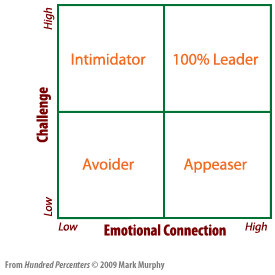
Mark Murphy, CEO of Leadership IQ, says that the “two most important differentiating factors in separating exceptional from average leaders are Challenge and Connection.” Challenge is the extent to which a leader pushes his or her people. Connection is the strength of the emotional connection they build with their people. You need to decide how much you want to challenge your people and how tight an emotional bond you want to build with them.

Working for the Appeaser. You’re given enjoyable assignments, you’re allowed to spend most of your time on work that plays to your strengths, your boss gives you lots of positive feedback, and your boss seems to care most about making sure you’re really happy.
Working for the Intimidator. You’re given seemingly impossible assignments; you don’t feel like you’ve got all the skills you need to complete those assignments; when your boss gives you feedback, it’s usually pretty harsh and critical; and your boss seems to care most about achieving his goals no matter who’s with him at the end.
Working for the Avoider. Your boss doesn’t really force too many assignments on you, you’re not really required to learn new skills, your boss lets you figure out for yourself how you’re doing, and your boss seems to care most about not getting in your way.
Working for the 100% Leader. You’re given really challenging assignments, you’re required to learn new skills even in areas you might not consider to be your natural strengths, your boss gives you lots of constructive and positive feedback, and your boss seems to care most about pushing you to maximize every ounce of your potential.
What kind of leader are you? What kind is your leader?
From The Leading Blog.
Working for the Appeaser. You’re given enjoyable assignments, you’re allowed to spend most of your time on work that plays to your strengths, your boss gives you lots of positive feedback, and your boss seems to care most about making sure you’re really happy.
Working for the Intimidator. You’re given seemingly impossible assignments; you don’t feel like you’ve got all the skills you need to complete those assignments; when your boss gives you feedback, it’s usually pretty harsh and critical; and your boss seems to care most about achieving his goals no matter who’s with him at the end.
Working for the Avoider. Your boss doesn’t really force too many assignments on you, you’re not really required to learn new skills, your boss lets you figure out for yourself how you’re doing, and your boss seems to care most about not getting in your way.
Working for the 100% Leader. You’re given really challenging assignments, you’re required to learn new skills even in areas you might not consider to be your natural strengths, your boss gives you lots of constructive and positive feedback, and your boss seems to care most about pushing you to maximize every ounce of your potential.
What kind of leader are you? What kind is your leader?
From The Leading Blog.
06 August 2010
The 12 elements of great leadership
To identify the elements of worker engagement. Gallup conducted many thousands of interviews in all kinds of organizations, at all levels, in most industries, and in many countries. These 12 statements - the Gallup Q - emerged from Gallups pioneering research as those that best predict employee and workgroup performance.
1. I know what is expected of me at work.
2. I have the materials and equipment I need to do my work right.
3. At work, I have the opportunity to do what I do best every day.
4. In the last seven days, I have received recognition or praise for doing good work.
5. My supervisor, or someone at work, seems to care about me as a person.
6. There is someone at work who encourages my development.
7. At work, my opinions seem to count.
8. The mission or purpose of my com company makes me feel my job is important.
9. My associates or fellow employees are committed to doing quality work.
10. I have a best friend at work.
11. In the last six months, someone at work has talked to me about my progress.
12. This last year, I have had opportunities at work to learn and grow.Think of great team experiences you had and count how many of those were there (or bad team experiences that those 12 were not there). Which ones?
29 June 2010
Competency development through AIESEC
When I say that I learned a whole lot in AIESEC, it's really enough learning to consider myself a different person. And this is not only on practical skills (like how to manage a budget), but also in my whole behavior as a person. I act differently. This, AIESEC calls competency development.
In AIESEC you can develop 5 competencies (that we believe are the competencies that leaders need to change the world for better). We track the development of these competencies checking how frequent you have certain behaviors connected to those competencies. We score them from 0 (not shown at all) to 4 (master). The competencies are:

In AIESEC you can develop 5 competencies (that we believe are the competencies that leaders need to change the world for better). We track the development of these competencies checking how frequent you have certain behaviors connected to those competencies. We score them from 0 (not shown at all) to 4 (master). The competencies are:
1. Global Mindset
Definition: Actively seeking to encourage diversity; shows openness and respect towards other cultures, works effectively with individuals of diverse cultures, styles and abilities, making optimum use of their insights and ideas towards the fulfillment of goals.
2. Entrepreneurial Outlook
Definition: Demonstrating ability in coming up with and implementing new ideas, organizing and managing resources and opportunities, engaging and influencing others, taking risks and finding innovative solutions to increase performance.
3. Social Responsibility
Definition: Approaching social, economic, environmental issues in a sustainable manner and taking a prompt action for improvement while considering the long term consequences of actions and the involvement of others.
4. Emotional Intelligence
Definition: Showing consistency and honesty about own intentions, motives, feelings, recognizing own feelings and those of others demonstrating respect, empathy and appropriate behaviour towards others; adjusting to different situations and personalities.
5. Proactive Learning
Definition: Demonstrating self-awareness, identifying areas for development of self and others; continuously increasing own/others knowledge and skills by trying different learning methods.
Want to know how do I rank on them? See the image bellow (the orange bars are the approximate score I had when I joined AIESEC, you can see I went through quite a development):

PS: my social responsibility and global mindset probably would be higher if I went on a development exchange.
And bellow are some of the things written about me by other people when they were evaluating my competencies:
And bellow are some of the things written about me by other people when they were evaluating my competencies:
Things that Sergio is good with:
Focusing on end results and targets - I think Sergio has very clear in his mind what the final results should be and he is personally focusing on it. Sergio does not let anyone he is working with lose sight of the end results and targets either.
Staying calm when faced with difficult situations - I believe Sergio has always shown an incredible calm when dealing with challenges and unexpected situations. This calm also brought solutions to the table.
Analysing information and situations - Active analysis of information provided gives Sergio an excellent understanding of situations which enables him to quickly deal with them.
Using knowledge and expertise effectively - Sergio has an impressive "database" of knowledge, techniques, procedures etc which he uses to accomplish what he wants to do.
Delivering on promises and commitments - Sergio would never take on something that he does not deliver upon. If he says he is going to do it, you feel confident that it will be done, and it will be done good.
Managing own workload efficiently - Sergio is really a role model on this area. He always manages his workload so that he finishes well before the deadline.
You can count on Sergio to…
… generate new ideas and implement them;
… to trust his team to do what they say they should do, but at the same time follow up to make sure it's done;
… have a clear idea on what he wants and how to get there. He is excellent at communicating this and at convincing people of the logic behind.
… act as a professional when needed, to reflect upon his own learning
… to be strict when he feels it's needed.
… give you a solution when you run out of or when you are in difficult situation.
… Always show and remind the direction the organization should head towards.
… Include people in planning, organizing, decision making.
… Listen to people's feelings
… Take the commitments he make in a working situation very seriously
… always be well prepared to start a process, meeting or whatever.
…give honest feedback
PS: of course I put only the good stuff, what are you thinking about? :)
28 June 2010
15 leadership lessons learned through AIESEC
In no particular order, the lessons I learned in my AIESEC experience:
1. It’s better to have no people than the wrong people – self-explanatory, but the thing is that when you don’t have anyone, at least you know you have a problem. When you have the wrong people, you fight to make them right and this generally fails.
2. Your team is a reflection of your behavior – when a team is down or up or anything, look at yourself as team leader. Inevitably you will be in the same state, so don’t get pissed off with them. Change yourself!
3. Get out of the throne and rush to the battle, your Majesty – it’s very pretty to say you are an strategic leader and sit in your office commanding the troops. Get out there and do stuff. Be present where the things are happening, because you can impact a lot by being an example in the battlefield, not in the board room.
4. People are different, accept and act accordingly – we all like to think we are unique, except when we want people to agree with us. Accept that people are different, they value different things and need to be treated not as you would like to be treated, but as they would like/need to be treated. Some people need pushing, some people need pulling, most people need both in different times.
5. Top down looks smart, but it’s dumb – top down approach is a nice temptation, but it will work much better if you can involve the bottom and middle (or parts of it) in the change. It’s dumb to come up with solutions that considers only the upper organization ‘s viewpoint, use multiple perspectives.
6. If middle management is not onboard, your boat won’t sail – leaders and managers that make things happen are a huge bottle neck for change (or the most awesome lever). What do you want them to be? Get them onboard early.
7. Make it simple, as simple as you can – complexity looks professional, but it’s just a lame way to solve problems. Look at Google, anyone knows how to use it because it’s damn simple.
8. You can’t build Rome in a day – change takes time. Plan accordingly – or conservatively.
9. Focus, focus, focus – you know you can’t build Rome in a day, but you also can’t build it all at the same time. So choose wisely what you want your organization to be doing and focus on it as hell with consistent behavior and messages that reinforce what you want to focus on.
10. Whole human-being is not a theory, is a fact – humans are not rational machines. There is at least 3 equal parts in humans: emotion, sensation and rational. Tap into those 3 human perspectives to lead effectively.
11. Adapt the job to the people, not the other way around – use people’s strengths when allocating responsibilities and don’t be trapped in functional job descriptions. In the end, the only thing that matters is to achieve the vision while making the mission happen. Complicated organization structures and systems should help you perform, not make it harder.
12. Accept reality and act upon it – it’s very easy to get trapped in an ideal world where things should be different. Accept what things really are and act as they are, not as they hypothetically should be.
13. Simple and visible plan – Simple plan, with clear and measurable goals, clear action, responsible and deadline. Make it visible also – we’ve put our plan and scoreboard on the wall, it was simple perfect.
14. Trust the team – if you heard hint number 1, you should have only quality people. Stretch their potential by giving them more and more trust and larger and larger responsibilities. You will be 80% of the time surprised positively.
15. Have a strong vision for direction and put all your efforts in it – and then use hint number 9: focus, focus, focus, while also taking an active decision to not focus on some things, important or urgent as they might be. If you need to do many things that are not on the vision or your vision is wrong/incomplete or your work is wrong.
25 June 2010
I wouldn’t exchange my AIESEC experience for a full scholarship in London Business School
And that is 100% true. I wouldn’t exchange the experience I lived in AIESEC for anything, especially not a scholarship in any of the top ranked MBA schools in the world. This is no empty rhetoric - I had to leave attractive things to be in AIESEC. I left a career that was giving me a reasonable amount of money to get more involved in AIESEC and after I also left the business I created (and was starting to become profiting enough to put a smile on my face) to come to AIESEC Norway and get a more challenging experience.
I joined the local committee of AIESEC in Porto Alegre. I was terrible with people (I could only get things done by fighting people and threatening them). My first assignment was to explain what was AIESEC to a classroom with around 10 people. I barely knew what AIESEC was. I was so nervous I was shaking and my voice failed.
At that time my local committee was in rags, there was a severe retention problem and lack of pipeline for leadership. Results were down. Randomness was everywhere. It was not pretty to see. I had 2 choices: quit as most of the people did or apply to local executive board to change that and make it happen. It was a hard decision, because if wanted to be executive board, I would have to quit my well paid job in advertising, because I couldn’t handle both. But I needed the money. What I did? I decided to apply (and I got selected to vice-president human resources of that local committee) and I also decided to open my own advertising agency with other 2 colleagues, so I could manage my own time.
December 2005 until December 2006 – first leadership role
1 – support all the AIESEC business units in Brazil to implement a development framework to increase the awesomeness of the experience lived in AIESEC
How can this organization provide such a powerful learning experience?
It’s simple, it doesn’t use the principles practiced by most schools: instead of classrooms and teachers, AIESEC give you the opportunity to be an integral part of the business, from the very operational level to the highest leadership position. It is learn by doing. We have the opportunity to work towards ambitious goals, work alone and in teams, manage budgets, sell to students, companies, NGOs and government, solve problems, deal with crisis situations, create and execute and change process, well, basically ANYTHING that you can learn in practice in a business, we do in AIESEC. In real life. No simulation. We are out there creating value or going bankrupt.
The difference of AIESEC and a business? While in a business you would take at least 10-20 years to get to top leadership of an international organization present all around the globe, in AIESEC we do it in from the 1st year – after you learn the basics, you are pushed out of the warm nest to fly or die. How? In our 800 business units in 107 countries we change the whole leadership every year. Every single year, since 1948. Talk about learning fast, adapting and keep growing anyway. We have a saying in AIESEC that “you are never prepared to your current position. You are only prepared when you are leaving the position and going for something even more challenging”. It’s about swimming or sinking.
Example? I will summarize my own experience (ok, it’s a big summary, but it’s really only 1% of what happened):
April to November 2005 – member of AIESEC
I joined the local committee of AIESEC in Porto Alegre. I was terrible with people (I could only get things done by fighting people and threatening them). My first assignment was to explain what was AIESEC to a classroom with around 10 people. I barely knew what AIESEC was. I was so nervous I was shaking and my voice failed.
 |
| Part of the team that evaluated the students that applied to join AIESEC |
.JPG) |
| Executive board selection - the people selected are pushed into the pool |
Being executive board in AIESEC Porto Alegre (or, how we say it “@PA EB”) was my first intense team experience and probably the biggest leadership development leap I had. From a struggling local committee of 10 people, we raised AIESEC Porto Alegre to a performing LC of 60 members. In the end, we won the AIESEC-Phillips award of best local committee in Brazil. The best part is that AIESEC Porto Alegre became a sustainable local committee that today is much stronger than when we left and their results beat the crap out of our term. Well done, Porto Alegre!
 |
| The No Fluffiness executive board |
 |
| AIESEC Porto Alegre, best local committee of Brazil in the year 2006 |
In this year my competencies had a jump: I learned a lot on results orientation, emotional intelligence, change management, building and managing a high performing team (I lead a 14 people team), focus, leading by example, coaching, training and facilitation (I was a trainer for around 100 people and I was not shaking anymore!), planning (we even used the balanced scorecard), expectation setting, well… I learned a lot. In this year I was not a common university student anymore, I knew how to get things done. During this period I also learned about finances and general management on my own advertising agency, but I can say that I much more learned in AIESEC and applied what I learned in my business than the other way around.
 |
| First time I was a trainer in a national conference |
 |
| The very first team I lead |
December 2006 until December 2007 – national leadership role
I got a glimpse of leadership in the previous year, I wanted more. So I applied to the amazingly fancy title of “National Strategy Leader – Brazilian People Development Framework” (or “NSL BPDF”, AIESEC has awesome titles, no?) which I translate to the non-AIESECers simply as National Learning Coordinator.
During this year as National Learning Coordinator I had basic 2 roles (each of them were 6 months):
1 – support all the AIESEC business units in Brazil to implement a development framework to increase the awesomeness of the experience lived in AIESEC
2 – lead a team responsible for creating talent management tatics and support the implementation of those in all Brazilian AIESEC business units.
And a 3rd role that was part of both roles above: design and deliver conferences/trainings. That’s where I spoke in trainings for around 600 people and I was completely fine with it. How much my comfort zone stretched.
 |
| The first national board team days |
 |
| That's the amount of people I was training in national conferences |
December 2007 – failing
In the end of my term as national learning coordinator, I had 2 obvious choices: 1) don’t take a new leadership role and leave the organization or go on exchange; 2) take a full-time leadership role as Vice-President in the AIESEC National Board.
I was convinced that I would take the 2nd option, but then the President of AIESEC in Brazil at the time (Mauricio, that also wrote an awesome post when he left AIESEC) asked me if I was interested for running for president of AIESEC in Brazil, not vice-president. The idea sincerely never stroke my mind until he talked to me. I gave it consideration and I decided to apply. I had faith in my skills that I could get the job done, even though it would be for sure a huge challenge. If I was elected as president of AIESEC in Brazil, I would have the role of delivering the biggest operational growth the organization ever had and also deliver the AIESEC International Congress, which is a more than 500.000 euros budget, at the same time.
3 people applied to be president of AIESEC in Brazil and none got elected. I don’t know why the others lost, but I know why I did: I was arrogant. I believed that my smarts and skills, allied to my logic would lead me to being elected. I forgot the most important lesson I learned in my first leadership experience: people don’t act/think like me, we are all different.
I learned a lot the value of emotional engagement in leadership, too bad it was late.
June 2008 until June 2009 – vice-president human resources in Norway, not exactly a fail, but feeling like a huge failure
After losing the election in Brazil, I decided I didn’t want to be a vice-president in Brazil – it wouldn’t be challenging enough for me, I had done so much in the talent management area nationally in my previous role that I wanted something different. So I decided to apply to vice-president human resources in another AIESEC country! Yes, because AIESEC is an open platform, if you are a member of AIESEC, you can apply to AIESEC anywhere in the world.
I made a list of all the countries that had open application for vice-president HR and the first earliest application deadlines were UK and Norway. I applied to both, got selected to Norway and then withdrew my application from UK. I was now a leader in the AIESEC Norway national board.
That was not an easy year and it made me learn as hell. Besides cultural shock of the country, I discovered that also the organization mentality was very different. AIESEC Norway was ill: severe cash flow problems, underperforming in every area, uncommitted members, huge retention rate problems, etc. It was not the strong AIESEC in Brazil that I had just left.
 |
| The 2008-2009 AIESEC Norway executive board |
It was so hard (and our leadership was not exactly awesome) that by around January (half a year of our term) the team had a huge break down. With this I learned the importance of the right selection and also building the team early, because if you don’t build it, the team will build itself – without any control and the results might be bad, as they were.
Again in January I had another choice: leave AIESEC Norway, defeated, or rise up once again and apply to President of AIESEC Norway. I took the steeper route, applied to President. And I got selected – this time I didn’t forget the importance of emotional engagement in the vision. What I wanted for AIESEC Norway is to turn it to be AIESEC everyday. Generating the kind of experience that got me until here, every single day. At that point of time, it was only a bold statement. We were far away from it, poor AIESEC Norway.
 |
| On my president candidacy speech |
 |
| Selected the 2009-2010 president of AIESEC Norway |
June 2009 until June 2010 – The Big Bang Team, big success!
I am still a bit shy when people talk to me and mention that fact that I am a president. It somehow doesn’t feel right. But besides being uncomfortable with the title, I must say that I never had a better, more challenging and pleasant job than being the leader of AIESEC Norway (or, how we would say it here, AIESEC Norge daglig leder).
I was lucky to selected the most hardcore and resilient team I ever saw. We started also with cash flow problems (only 15.000 in the drift account and average monthly cost of around 100.000), people quitting, lack of performance, uninterested members, etc. In the first 6 months, I think it was the hardest time of my life so far. But my team was simply awesome, we were far far more than the sum of our individualities. We managed to use our strengths, be flexible, put ourselves together and change AIESEC Norway from down to up.
 |
| The first team days of the Big Bang team |
The things that we did as a team:
- Break the record of outgoing exchanges raises (previous year was 40+- and in our year was 70+-)
- Break the 20 years performance record of 40-55 exchanges per term
- Starting with 15.000 NOK in the drift account and finishing it with 350.000
- Having operational profit! (thanks to a diversification of revenues and innovative products)
- Had a major culture change in the organization (a problem that was there for 15-20 years). Today we only have performing members that are in AIESEC for the right reasons and working hard. (2 of the main things here were to fire the underperforming half of our membership and change the financial model.)
- Had elected better executive boards elected than previous term
- Exchange happening EVERYDAY (the dream came true!)
 |
| Our first national conference - in the DnB Nor Leadership Development Day |
AIESEC Norway today is a different organization. Much better. Still with a long way to go to be strong, but we started it. The Big Bang Team name was prophetic - we were indeed the beginning for a new AIESEC Norway.
 |
| The first time I felt like leading a country - Fyru Fyru! |
It was a pleasure to serve AIESEC Norway, but now it’s time to leave the stage to the new generation, because they also need to learn and take AIESEC to the next level. I know, looking to the new National Executive Board and the Local Committees Presidents that AIESEC Norway 2010-2011 will kick the ass of my Big Bang team in terms of results.
 |
| Most awesome team ever |
Thanks you so much for my whole experience, I can only be grateful to AIESEC for all those years. They were the best in my life until now.
 |
| As musicians, we are very good leaders |
 |
| Fyru! Fyru! The sound of achievement! |
Subscribe to:
Posts (Atom)