Showing posts with label technology. Show all posts

03 July 2011

My Google+ predictions

If you are oblivious about what is Google+, please stop right here and watch this. All the rest of you that are not my mother may keep reading.


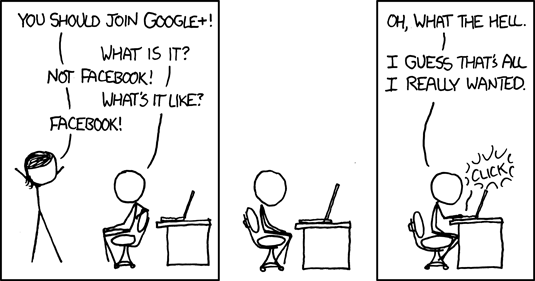
Like the comic above, that is how most people are seeing Google+.

I don't. 

Disclaimer: I am a Google groupie (but I don't particularly hate Facebook, I find it a great tool).

But my prediction about Google+ is that it will win the hearts of the people who have less time for randomness and are more interested in filtering the never ending "I am eating an apple" and "Wow, big poop today". It will become the main tool for meaningful online social interaction.

Why? Good that you asked:

There are 2 key features that distinguish it from Facebook: Circles and Hangout.


Circles

Sometimes I want to share something that everyone might be interested, so I can include all those in the communication. But sometimes I might be feeling down or I got a job offer and I want only to tell my close friends, not everyone. Or, even better, I want to share something only with the people that live in Chennai or only those friends that speak Portuguese. Each of those can be a circle (and a person can be in more circles, for example, I have a circle with my Big Bang team and all of them are also in the circle "close friends", which includes other people also.

How this changes the game: circles will make the smart people think about target audience before they post something. This will reduce the amount of random information one gets, which will lead to more meaningful interaction.

Example:
I was going to share the trailer of a documentary about the making of indie games. Typically on Facebook & Twitter I would just share. In Google+ I thought "hmmm, that really does appeal to only part of my friends, the geek ones, I will make a circle and only share it with them". All the rest of my friends that does not have interest for my geeky stuff will just stay oblivious. I am not interrupting them.

The challenge: for this to happen, people have to be disciplined enough to a) create relevant circles (which demands a bit of time in the beginning) and b) don't act as complete idiots and think about "who would be interested in that post?" Since in the beginning only the tech-savvy will be joining, there is a good possibility it will happen, but once my mom and the rest of the family come (if they will), then I am not sure.


Hangout

Do you have those times where you are really not doing anything and just want to chat with someone randomly? Well, hangout is for you then. You just press a button saying you are starting a hangout and you are moved to a virtual room with video chat and people can come to chat with you. 

"Oh, this is not new! It is Chatroulette! It has only perverts chatting with strangers!" will scream the troll.

No, no, my dear troll friend, the catch of the hangout is simple: only the people in specific circles of your choice may join the hangout. I am a almost 30 year old guy, when I was young there was no web or even mobile phones (yes, there was a time those didn't exist!), how did we meet our friends? We used to HANGOUT in the same place and time, so the people from that group would join eventually. Like the cafe where the people from Friends used to go.

How this changes the game: I want to talk, but I am not available to everyone, I am available to only a few friends. It also removes the barrier to "schedule a chat" or anything like this in Skype. You just start hanging out and a friend will join to chat. It just blew my mind - and I didn't even talk about the extra spicy stuff, like this room can have up to 10 people using video chat, you can share Youtube videos that you all see at the same time, etc.

The challenge: without critical mass (a lot of people using Google+), this is still only a gimmick.

Google+, you will put fear in Facebook, Twitter and Skype. I want you to win.

08 December 2010

Gamefication: it’s time to use in complex gadgets

Not all gadgets are magically intuitive like the Nintendo Wii or an iPhone. Some tend to be rather complex, like for example the DSLR cameras (for the ones not versed into photographer’s jargon: those digital cameras, semi- or professional, with lenses that can be removed and changed and have more regulation possibilities). Today they are made to operate quite automatically (just like a point and shoot – or “normal” digital camera), but if you get a camera like this, HOPEFULLY you want to do more than pointing and shooting.

The thing is: those DSLR cameras are complicated. The interface is not so intuitive. I just got one of these cameras and I spend the night juggling with menus and buttons until I managed to know the basics of operation. And I am not a complete amateur: I used SLRs before and I understand the basics about focus, aperture, shutter speed and such. It took me “only” 3 hours to know the very BASICS, and only because I knew what I was looking for. If you don’t know where to start (most people who never handled a SLR camera), I imagine this would be so frustrating you would actually just use it as a point and shoot camera.

Finally the point of this post: if you use tutorial level game mechanics, you could solve this with a simple CD or website. Imagine you open this camera website and it teaches you step by step how to mount the lenses on the camera and insert the batteries (then it obviously give you some % completion status bar progress). Then it teaches you how to take a point and shoot picture (congrats, you qualified to upload your pictures and participate in this months amateus photo contest). Then how to regulate the shutter to create frozen or movement images (Congrats, you get 10 points to vote in others people’s pictures). Then how to wide or narrow the field of depth. Then timer. Then manual focusing. Then using or not flash. Etc etc etc until you get to the really advanced stuff. Imagine also if you could share your tutorial level first pictures and vote for the best ones of the month and then get some gift! Or even just a badge of honor as good photographer.

Please, gamefy my experience so I can have fun while learning something complicated. Just like a game, teach me the basics and then challenge me bit by bit until I am fairly confident in handling it. When companies which should in theory be full of nerds will use game mechanics instead of 300 page manuals?

09 November 2010

Gamefication 101 with Gabe Zichermann

It's not about games, but about using game-like mechanics to make things better (one old example of gamification is the "collect 10 coffee stamps, get one free" or similar). From Foursquare to Farmville and from Nike to the Navy, game mechanics like points, badges, levels, challenges, rewards and leaderboards are being used in ever greater numbers. But what does this mean for "traditional" marketing & UI/UX and how do you leverage this trend in your engagement strategy? Moreover, how do we measure success, and why will every company have a Chief Engagement Officer in the next few years? Find out more in this in-depth discussion with Gamification Expert, Gabe Zichermann - author of "Game-Based Marketing" and the Gamification.co blog, and Chair of the Gamification Summit.

08 November 2010

7 ways games reward the brain (TED Talk)

Smart TED Talk that looks like is about videogames, but it is in fact about our brains and what are the most important game mechanics (such as leveling up and probability of reward) that could be applied to the real world in business, government, education, to fight global warming, etc.


Tom Chatfield: 7 ways games reward the brain.

What would happen if you used game mechanics outside of games, such as in education and the business world? Can you imagine a game based workplace?

07 October 2010

Corporate communication still didn’t go 2.0

Lots of companies I know communicate like this: from boss to subordinate to subordinate of the subordinate and it goes on, until it reaches the factory and client service personnel. Still companies are surprised when the ground level doesn’t seem to understand the messages from the top, failing to act accordingly.

But is that really surprising? Have you ever played that game when you whisper a phrase into someone’s ear and it goes like this until it’s completed a full cycle? If you did you also know that the phrase passed is never the same and the message is always a bit (or a lot) distorted from the original one, sometimes being something completely different and senseless.
Eventually there is also intranet articles, which most people don’t read so much . But communication is a trick thing, I have a very practical example of how it can go very wrong even in the simplest of messages. This happened where I work: an e-mail was sent by the facility management to all employees in our building. The e-mail was only one line and it couldn’t be more straightforward than it was:

“On Thursday, 7th of October, at 9pm the water will be very hot.”
Then we sat during lunch with 5 people and this e-mail was one of the subjects. Surprisingly, from 5 people, only one had understand all the critical messages: 1) water very hot, 2) Thursday, 9th of October, 3) 9 pm. All the others understood the day the event would happen perfectly, but 2 people thought it was 9am, one thought it was the whole day on and one was uncertain about the time.

Communication is a tricky thing, but business keep insisting that cascading information is a great way of communicating.

In a word where technology is increasingly about connecting people, why not to rely on the power of the social network, instead of the power of the formal network (the hierarchy), to communicate? In a world where more and more the individual has the means to reach and interact with the masses, why do so many companies rely on the “broadcast” communication model that shaped the LAST century? What is most interesting is that on the marketing approach, lots of organizations already understand (or at least accept) this and are moving more and more to social communication and influencers.

Would it take so much to implement the modern market approach in an organization? Yes, is the answer, because the big bosses at the top usually see the consumers as the market’s bosses, while they see themselves as the company’s bosses. While there is not a shift in mindset towards the belief (and push) for the “linchpiness” of every individual, communication will be hierarchical, the chain of command will give orders to people to follow and people will be cogs in the machine: cheap and easily replaceable.

Is there a movement for change? Certainly, just look for example at Philips: they launched its social community in Social Cast to unite tens of thousands of employees across the globe. It’s a bit like Twitter, but only employees have access. So you can share what you are working on, ask questions for the people following you (or to the groups you are in). Imagine this: the most proactive people (linchpins?) would not wait for the sales manager to talk to them, but they would instead follow the sales manager profile. This opens a whole new range for leaders (not bosses) influencing large parts of the organization.
But do companies really want to go through the scary path of leaders not being bosses?

01 October 2010

Empathic civilization

Great, great thoughts on how technology (in fact a more connected world because of technology) can expand the perception of who is close to you beyond family, tribe, neighborhood or nationality into a world where everyone is closer, thus more empathic. And this is no theory, it's already happened and this video shows at least one clear example:

25 September 2010

IDEO: 3 ideas about the future of books

Nihilists always announce the death of stuff when new stuff shows up. The radio was announced dead after the TV, but it just changes. Same thing about books, we won't get rid of them (thanks god!), but they will for sure evolve. How will the book evolve? Check out the amazing 3 ideas from IDEO's video:


The Future of the Book. from IDEO on Vimeo.


I liked specially the last one, where we can turn books into interactive fiction. Imagine the appeal a Harry-Potter-like book would have in millions of children if you also would include game elements in it? Imagine the potential of interactive books can have in education (if of course our educational system evolves at all).

22 September 2010

Crowd accelerated innovation

Brilliand TED talk by Chris Anderson (founder of TED), where he speaks about how web videos can power (and accelerate) innovation all around the world. Very inspiring, specially for me, when in the end he mentions (and shows) how crowds can actually improve everyone's life by learning and teaching.

10 September 2010

Evoke - the game that is a crash-course in changing the world

Addendum to the previous post: Games can change the world.

Interview in CNN where Jane McGonigal talks about Evoke, the virtual game that teaches people how to create positive change in the real world:


And the promo video of Evoke:


EVOKE trailer (a new online game) from Alchemy on Vimeo.

Games can save the world

I am passionate about education and I believe one day I will be involved in something around it. I am also a passionate gamer, so recently I've been flirting with the idea of introducing games in schools that would enhance children's learning. Please note that I am not talking about the unimaginative educational games, but real games and/or game mechanics applied to the classroom.

That's when I crossed paths with this amazing TED video:

Jane McGonigal: Gaming can make a better world


Not to forget, of course, the Swedish VW example of the game theory in practice, one of the videos of The Fun Theory:


Care to share any insightful ideas after this? :)

27 March 2010

"Any sufficiently advanced technology is indistinguishable from magic"

No wonder this video has almost 1.5 million views, I never imagine this kind of thing would be possible, but the new Photoshop can do it:

24 March 2010

Electric highway

So, Brazilian researchers discovered a way to create electricity from the traffic of cars - it's a special material that can be covered by asphalt and remain with its electric properties.

If you have an increasing volume of electric cars and the movement of the cars generate electricity, that would be really cool, especially in a traffic heavy nation like Brazil, where most of the production is distributed by heavy trucks and such. What about if this would be distributed straight to the public lights?

Now it's just thinking how/when this can be implemented in a large scale that would actually make a difference?

Source: Fiat Mio.

30 May 2009

Google Wave: what e-mail would be if it was created today

Google never stops to amaze me with their out-of-the-box thinking. They just pulled off a new product that has the bold intention to change how we communicate and collaborate using the web.

And I must say that it's very impressive. This video is their first presentation of Google Wave. I believe the only person interested in it now will be the early birds in technology usage, but I do believe that in the long run (which is not so long when we speak about the fast paced tech world) this can be one ground breaking way of communicating and collaborating in the workplace, with clients, family and so on. It's a true communication tool, just like e-mail is today.


http://wave.google.com/

This is not a wave, but, hey, what do you think of it? Is it so promissing or am I (and them) overestimating?