Addendum to the previous post: Games can change the world.
Interview in CNN where Jane McGonigal talks about Evoke, the virtual game that teaches people how to create positive change in the real world:
And the promo video of Evoke:
EVOKE trailer (a new online game) from Alchemy on Vimeo.

10 September 2010

Games can save the world
I am passionate about education and I believe one day I will be involved in something around it. I am also a passionate gamer, so recently I've been flirting with the idea of introducing games in schools that would enhance children's learning. Please note that I am not talking about the unimaginative educational games, but real games and/or game mechanics applied to the classroom.
That's when I crossed paths with this amazing TED video:
Jane McGonigal: Gaming can make a better world
Jane McGonigal: Gaming can make a better world
There is also a HBR article about examples of how game mechanics can be (and are) applied to real life situations. And a complete list of game mechanics by the Google Gaming team (or the ridiculous name of SCVNGR).
Not to forget, of course, the Swedish VW example of the game theory in practice, one of the videos of The Fun Theory:
Care to share any insightful ideas after this? :)
07 September 2010
Good leaders shield their people from wasting their time and organizational idiocy
The article is in fact "Why good bosses tune in to their people" in McKinsey Quarterly, but I found particularly good the part that says about shielding their followers - something that I recon, in the beginning of my term as president, I didn't do so well, but then I think I managed to improve. Here is that part of this interesting article:
The best bosses invent, borrow, and implement ways to reduce the mental and emotional load heaped on their followers—and protect them from the incompetence, cluelessness, and premature judgments of fellow bosses or others who can undermine their followers’ work and well being. Followers who enjoy such protection (and who may be bosses themselves) have the freedom to take risks and try new things.
Annette Kyle, for example, managed some 60 employees at a Texas terminal where they loaded chemicals from railcars onto ships and trucks. In the mid-1990s, Annette led a “revolution” that dramatically raised her unit’s performance through a host of changes, including better planning, greater responsibility at the lowest levels, improved and more transparent metrics, and numerous cultural changes. She personally sewed “no whining” patches on workers’ uniforms, for example, to discourage the local penchant for complaining and auctioned off her desk to workers for $60 because, as she explained it, “I shouldn’t be sitting behind a big desk. I should be contributing to team goals however possible.”
This transformation virtually eliminated the penalties that were levied when ships arrived at the terminal’s dock but (despite considerable advance warning) workers weren’t ready to load them. These “demurrage charges,” which cost the company $2.5 million the year before the revolution, were down to $10,000 the year after. Previously, it had taken more than three hours to load an average truck. Afterward, more than 90 percent were loaded within an hour of arrival. Surveys and interviews by University of Southern California researchers showed that employees became more satisfied with their jobs and felt proud of their accomplishments. I asked Annette how she could make such radical changes in her giant company. She answered that her boss shielded her from top-ranking managers—he found the resources and experts she needed but never discussed these moves with senior management until they succeeded.
Good bosses are especially adept at protecting their people’s time—for example, by eliminating needless meetings. Take a cue from Will Wright, designer of computer games such as The Sims: rather than automatically scheduling meetings, ask yourself if they are really needed. Wright employed a clever trick. Every time someone called a meeting, he charged that person a dollar. Although he collected a lot of dollars, this requirement made people “think twice, even though it was only a dollar.” He also used an employee-centered method to keep meetings short—inviting the creative but impatient artist Ocean Quigley, “the canary in the coal mine.” When Quigley raised his hand to be excused, “we knew that the meeting had hit diminishing returns.”
26 August 2010
How to make a Gantt chart on Excel video (brilliant!)
I am now responsible for taking care of the plan in my team (my previous and dear team will laugh at me), so I came up with an awesome way to plan using Excel:
16 August 2010
Learning leadership again and again everyday
According to a research made by the Corporate Leadership Council, the ten most important leadership characteristics are:
1. Honesty and integrity
2. Clearly communicate expectations
3. Recognize and reward achievement
4. Adapt to changing circumstances
5. Inspire others
6. Put right people in right roles at the right time
7. Passion to succeed
8. Identify and articulate long-term vision
9. Persuade and encourage others to move in the desired direction
10. Accept responsibility for successes and failures
Sounds great and I fully agree they are definitely outstanding characteristics that will make a leader successful. BUT, here is the catch, no one can be perfect in all of those, all the time, with all the people. Read the list again and check out, each of these characteristics can be subject to very wide interpretations. And, if there is big room for interpretation, there is a big room for the same behavior that subject A consider as “honesty and integrity” be considered “too direct and hash” by subject B. Worse: the same behavior can be identified as “honesty and integrity” or “too direct and hash” by the same person, depending on the mood he/she is in the moment or the subject the leader is touching.
What now? Despair? Chaos?
No, business as usual for leaders: adapt constantly to the people. For each person, you have to “learn” leadership again. Maybe even for every moment. Leadership is being 100% present at the moment – which is weird because one of the main characteristics of leaders is to look to the future and articulate the long-term vision. Well, no one said it would be easy :)
1. Honesty and integrity
2. Clearly communicate expectations
3. Recognize and reward achievement
4. Adapt to changing circumstances
5. Inspire others
6. Put right people in right roles at the right time
7. Passion to succeed
8. Identify and articulate long-term vision
9. Persuade and encourage others to move in the desired direction
10. Accept responsibility for successes and failures
Sounds great and I fully agree they are definitely outstanding characteristics that will make a leader successful. BUT, here is the catch, no one can be perfect in all of those, all the time, with all the people. Read the list again and check out, each of these characteristics can be subject to very wide interpretations. And, if there is big room for interpretation, there is a big room for the same behavior that subject A consider as “honesty and integrity” be considered “too direct and hash” by subject B. Worse: the same behavior can be identified as “honesty and integrity” or “too direct and hash” by the same person, depending on the mood he/she is in the moment or the subject the leader is touching.
What now? Despair? Chaos?
No, business as usual for leaders: adapt constantly to the people. For each person, you have to “learn” leadership again. Maybe even for every moment. Leadership is being 100% present at the moment – which is weird because one of the main characteristics of leaders is to look to the future and articulate the long-term vision. Well, no one said it would be easy :)
07 August 2010
Become a 100% leader
Mark Murphy, CEO of Leadership IQ, says that the “two most important differentiating factors in separating exceptional from average leaders are Challenge and Connection.” Challenge is the extent to which a leader pushes his or her people. Connection is the strength of the emotional connection they build with their people. You need to decide how much you want to challenge your people and how tight an emotional bond you want to build with them.

Working for the Appeaser. You’re given enjoyable assignments, you’re allowed to spend most of your time on work that plays to your strengths, your boss gives you lots of positive feedback, and your boss seems to care most about making sure you’re really happy.
Working for the Intimidator. You’re given seemingly impossible assignments; you don’t feel like you’ve got all the skills you need to complete those assignments; when your boss gives you feedback, it’s usually pretty harsh and critical; and your boss seems to care most about achieving his goals no matter who’s with him at the end.
Working for the Avoider. Your boss doesn’t really force too many assignments on you, you’re not really required to learn new skills, your boss lets you figure out for yourself how you’re doing, and your boss seems to care most about not getting in your way.
Working for the 100% Leader. You’re given really challenging assignments, you’re required to learn new skills even in areas you might not consider to be your natural strengths, your boss gives you lots of constructive and positive feedback, and your boss seems to care most about pushing you to maximize every ounce of your potential.
What kind of leader are you? What kind is your leader?
From The Leading Blog.
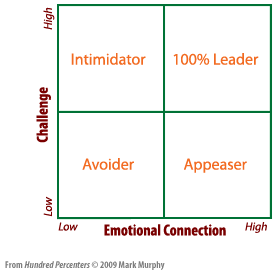
Working for the Appeaser. You’re given enjoyable assignments, you’re allowed to spend most of your time on work that plays to your strengths, your boss gives you lots of positive feedback, and your boss seems to care most about making sure you’re really happy.
Working for the Intimidator. You’re given seemingly impossible assignments; you don’t feel like you’ve got all the skills you need to complete those assignments; when your boss gives you feedback, it’s usually pretty harsh and critical; and your boss seems to care most about achieving his goals no matter who’s with him at the end.
Working for the Avoider. Your boss doesn’t really force too many assignments on you, you’re not really required to learn new skills, your boss lets you figure out for yourself how you’re doing, and your boss seems to care most about not getting in your way.
Working for the 100% Leader. You’re given really challenging assignments, you’re required to learn new skills even in areas you might not consider to be your natural strengths, your boss gives you lots of constructive and positive feedback, and your boss seems to care most about pushing you to maximize every ounce of your potential.
What kind of leader are you? What kind is your leader?
From The Leading Blog.
06 August 2010
The 12 elements of great leadership
To identify the elements of worker engagement. Gallup conducted many thousands of interviews in all kinds of organizations, at all levels, in most industries, and in many countries. These 12 statements - the Gallup Q - emerged from Gallups pioneering research as those that best predict employee and workgroup performance.
1. I know what is expected of me at work.
2. I have the materials and equipment I need to do my work right.
3. At work, I have the opportunity to do what I do best every day.
4. In the last seven days, I have received recognition or praise for doing good work.
5. My supervisor, or someone at work, seems to care about me as a person.
6. There is someone at work who encourages my development.
7. At work, my opinions seem to count.
8. The mission or purpose of my com company makes me feel my job is important.
9. My associates or fellow employees are committed to doing quality work.
10. I have a best friend at work.
11. In the last six months, someone at work has talked to me about my progress.
12. This last year, I have had opportunities at work to learn and grow.Think of great team experiences you had and count how many of those were there (or bad team experiences that those 12 were not there). Which ones?
Subscribe to:
Posts (Atom)